

By George Chitiyo, Ph.D.
Tennessee Technological University
Chess has a long history in schools, yet the field has lacked a global account of how school chess programs are organized, supported and evaluated. The 2026 FIDE Global Chess in Schools Survey, conducted for the FIDE Chess in Education Commission, was designed to address that gap. This article summarizes the main findings from the global survey and highlights their implications for policy and practice.
The Survey and the Scale of School Chess
The survey builds on a 2021 FIDE and European Chess Union study of 196 respondents, mostly national federations and predominantly in Europe (Hall & Nash, 2021). Conducted online between October 2025 and June 2026, the 2026 survey asked 33 questions, both closed-ended and open-ended, about program structure, funding, benefits, barriers and evaluation. There were 239 respondents from 100 countries on all five continents, representing national federations, schools, chess-in-schools organizations and other groups. Because respondents chose to take part, the results describe the responding programs rather than all school chess worldwide.
School chess reaches a very large number of children. Respondents estimate that close to 30 million children take part in the countries surveyed, about half of them in India. They are taught by more than 145,000 classroom teachers and about 22,500 outside or independent coaches. These figures rest mostly on respondents’ own estimates, so they give a sense of scale rather than an exact count.
How Programs Are Structured Around the World
Three markers offer a useful way to judge how established a program is:
- whether instructors need a formal qualification;
- whether there is a written curriculum that sets out what children should learn; and
- whether the program uses chess software or online platforms.
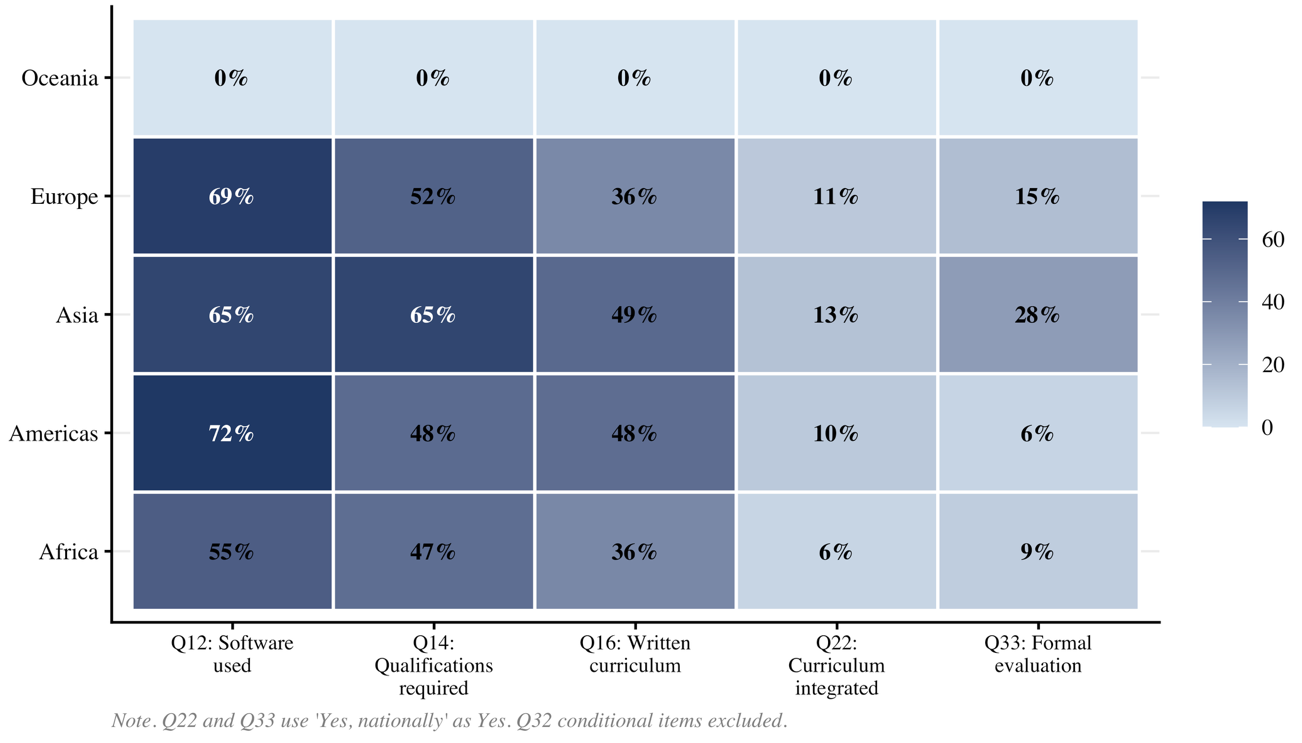
Comparing these markers across continents reveals two clear patterns. First, technology use is more widespread than formal teaching structures such as a written curriculum. On every continent except Oceania, where the two respondents reported none of the three markers, software use was the most common (tied with qualifications in Asia), and a written curriculum was the least common. The gap was widest in Europe, where 69.2% of programs use software but only 35.9% have a written curriculum.
Second, no continent leads on every measure. Asia had the highest share of programs requiring instructor qualifications (65.3%) and using a written curriculum (49.3%), while the Americas led on software use (71.9%).
Africa’s results deserve particular attention. Africa had more countries in the survey than any other continent (26) and more respondents than Europe. Nearly half of African programs (47.3%) require instructor qualifications, close to the Americas (48.4%) and Europe (52.5%). The share with a written curriculum (36.4%) is on par with Europe’s (35.9%). More than half of African programs (54.5%) use software, and a quarter (25%) report that chess is part of the official school curriculum, nationally or in some regions. Africa also leads all continents in deliberate efforts to include girls: 42.2% of African programs run specific initiatives for girls, and only 4.4% report that they do not actively promote girls’ participation.
Differences by type of organization were smaller. Between 51.8% and 55.8% of each group required instructor qualifications. Chess-in-schools organizations were the most likely to have a written curriculum (55.6%) and schools the least likely (35%).
Program maturity, therefore, has several dimensions, and a program can be strong in one area while lagging in another. The results also suggest that easy access to digital tools has not yet been matched by shared, written plans for what children should learn. Without such plans, it is hard to say what success looks like, and harder still to measure it.
The Chitiyo-Atkins Model of Chess Program Development
When respondents described their programs in their own words, a consistent pattern emerged: programs tend to reach the same milestones and in the same order. The Chitiyo-Atkins Model organizes these milestones into four stages of development. The model was built from the data rather than imposed on it, and it draws on the accounts of close to 90 countries whose responses gave enough detail to be classified.
- First move. An individual teacher, a single school or a newly founded federation makes a start, often from nothing. A first club is formed, first lessons are taught, and awareness campaigns begin. Activity depends on one or a few committed champions, and there are no formal structures, trained instructors or dedicated resources yet.
- Building foundations. The program invests in its two basic foundations: people and equipment. Teacher training and certification courses begin, chess sets and kits are distributed to schools, the first structured classes appear and the first school competitions are organized. Reach grows, but delivery still depends on projects and can falter if key individuals or funding are lost.
- Scaling and systematizing. Chess becomes a system rather than a project. Programs adopt structured or age-based curricula, hold regular regional and national school competitions, use digital platforms and online teacher courses, and build networks of coordinators and certified instructors. The program is sustained by organizations and routines rather than individuals, but it still lacks formal government status.
- Policy integration. Chess gains formal status in the education system. Signs of this stage include a dedicated government budget line, a formal partnership with or endorsement from the education ministry, chess as a required or elective subject in the official curriculum, accredited teacher courses, and national coordination and monitoring. The program no longer depends on any single champion.
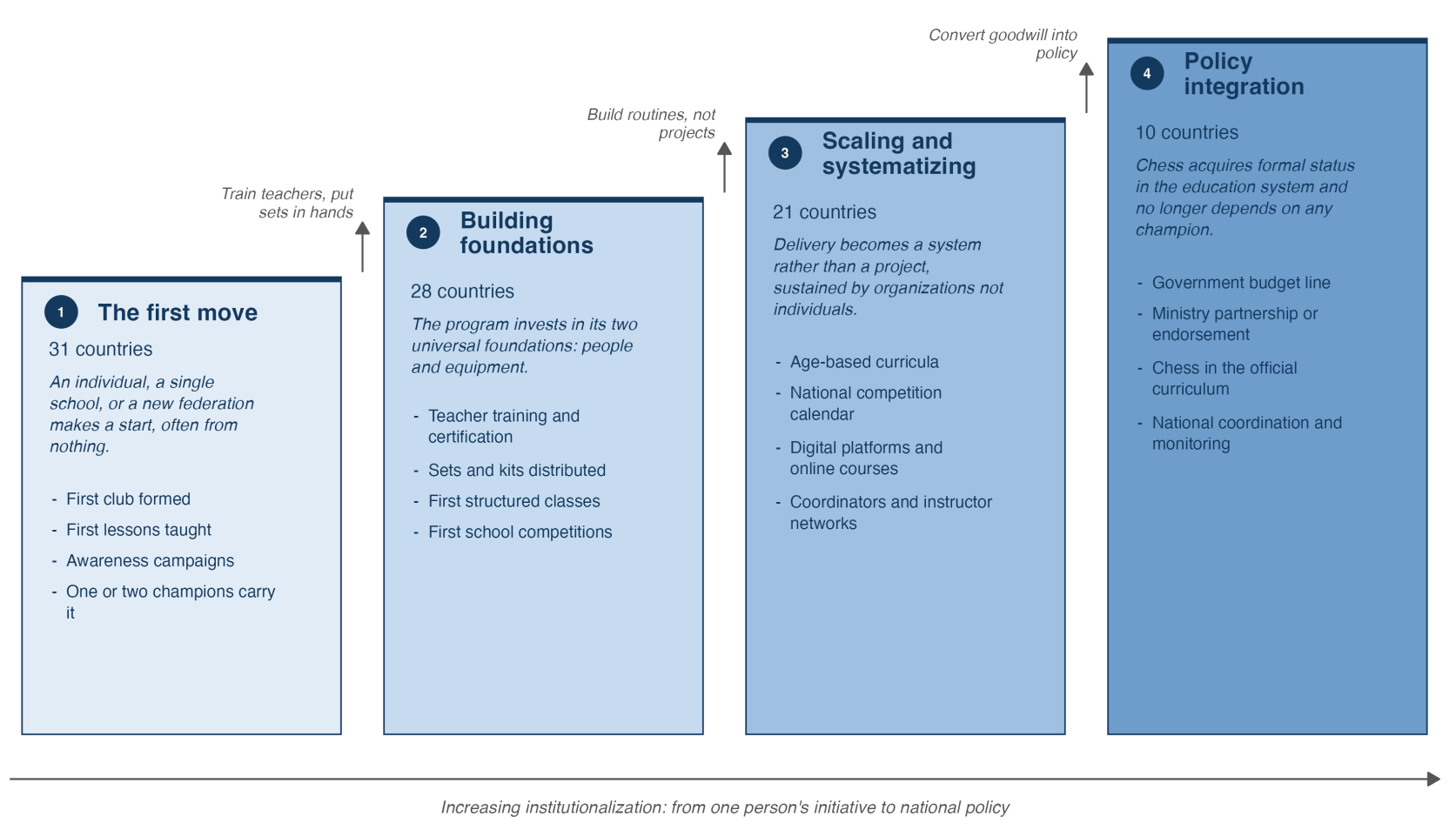
The model describes where programs are; it does not judge them or rank countries against one another. Progress is also not guaranteed, as programs can stall or regress when support ends. The model is most useful as a guide, showing each country what the next step usually looks like and where help could make the biggest difference.
Common Barriers to Growth
Programs at every stage and on every continent face many of the same obstacles. Funding is the most common: 79% of respondents named it among the biggest barriers. Parents are the most common source of funding, and government funding is rare, which limits growth and leaves programs vulnerable. Close behind are a lack of curriculum (67%) and a lack of trained instructors (66.5%). Strong players are not always good teachers, classroom teachers often lack chess knowledge, and many programs depend on one or two committed individuals. Programs also struggle with crowded school timetables and shortages of chess boards and teaching materials, especially in lower-income settings. Some parents, teachers and officials see chess as a pastime rather than a learning tool. Finally, rural location and language barriers limit access for children in remote or underserved areas.
These obstacles are shared across very different settings, and the survey shows that each has already been overcome somewhere. This suggests that solutions developed in one country can often be adapted for use in others.
Perceived Benefits of School Chess
Respondents see chess as valuable for children’s development in many ways. Improved academic performance was the benefit named most often (88.4%), followed by critical thinking, social skills and emotional regulation, each chosen by more than 70% of respondents. This suggests that chess is valued for the whole child, not for academics alone. Parents, teachers and school leaders appear to share this view: about three in four respondents reported that these groups had responded very positively to their programs.
Academic performance was the top benefit on every continent, but emphasis differed by region. Respondents in Africa and Asia placed more weight on critical thinking, while those in Europe gave more weight to social and emotional growth. Respondents also described gains in confidence, discipline and concentration, better classroom behavior, and in some cases less violence and bullying. Several programs reported wider social aims, such as reaching children who cannot afford school in Uganda and building a “girls teaching girls” model in India.
These accounts are encouraging, but they are largely perceptions. Whether chess delivers these benefits and for which children is a question beyond the scope of this study.
The Evaluation Gap
Nearly half of programs (48.2%) have no evaluation system, and only about one in seven produces formal evaluation reports. Evaluation is more common in established programs, especially those that require instructor qualifications and have a written curriculum, and those where chess is part of the national curriculum. Clear learning goals likely make progress easier to measure.
This gap matters for three reasons: funders and ministries want evidence before they invest, programs need feedback to improve, and shared measures would allow countries to learn from one another. Not every program needs a full research study. A step-by-step approach would work well: all programs could keep basic records, many could assess what children learn, and the most established could carry out formal studies of impact. FIDE could support this by offering a common framework, simple assessment tools and training.
Implications for Policy and Practice
The findings point to five priorities:
- helping countries at earlier stages learn from those further along;
- securing more stable funding, including support from public budgets;
- preparing teachers who can teach chess well, not only play it;
- developing shared, adaptable curricula with clear learning outcomes; and
- building evaluation capacity so that the benefits of school chess can be demonstrated, not only asserted.
Conclusion
Children around the world play the same game of chess at school, but under very different conditions. The 2026 survey shows that school chess reaches millions of children on every continent. Yet many programs still lack formal structures, and few can show formal evidence of their results. In chess terms, many countries have made a strong opening. The next phase, in which promising programs become lasting systems that can show their value, is still to come. Regular assessment and evaluation will be key to that progress, because the case for chess in schools will depend on the evidence the field can provide.
The full report, “From First Move to National Policy: The 2026 FIDE Global Chess in Schools Survey,” is available [HERE].
Reference
Hall, J., & Nash, J. (2021). FIDE-ECU chess in schools survey report. International Chess Federation & European Chess Union.
https://chessineducation.org/wp-content/uploads/2021/06/FIDE-ECU-Survey-Final-Report-rev.pdf