

The growth of chess in Africa
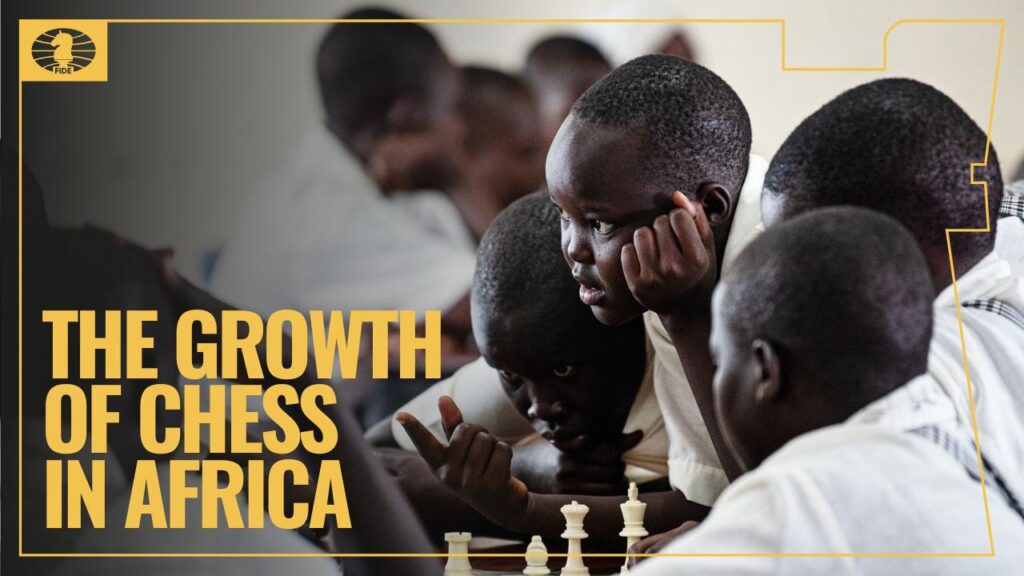
Since 1963, 25 May has been celebrated as Africa Day. It marks the founding of the Organisation of African Unity, when heads of state from 32 independent African states met in Addis Ababa, Ethiopia, to sign the OAU Charter. For chess, it is also a chance to look at a continent where the game is growing fast. Chess in Africa has expanded considerably since the 1960s. Out of 54 countries, 51 are members of FIDE. It is no longer about a few strong federations, but about systematic projects in schools, youth events, national and international tournaments, as well as projects for prisons, refugee camps, and women’s chess. The shift towards a greater emphasis on chess in Africa was noted by FIDE’s decision in April 2026, to approve a rotation principle for the Chess Olympiad, giving Africa priority for hosting the 2032 event. “With its cultural diversity and heritage, as well as having a growing young population, Africa has the greatest potential for chess growth in the world, and this is what we are trying to nurture,” FIDE President Arkady Dvorkovich said. “Over the years, FIDE has worked closely with African federations and international organisations on promoting chess at club and national levels, but also as a tool for social development and inclusion. Our vision is to help Africa host the Chess Olympiad in 2032 and use this as a catalyst for chess development in the continent,” Dvorkovich added. The growing chess landscape Since 1960, Africa has hosted two Interzonals (Sousse in 1967 and Tunis in 1985) as well as the FIDE World Chess Championship 2004, where Rustam Kasimdzhanov won the title. In 2011 the Commonwealth Chess Championship was held in Africa for the first time. In recent years the number of international events has grown, showing a clear shift. In 2023, the FIDE World Cadet Championships U8, U10 and U12 were held in Sharm El Sheikh, Egypt. The event had six sections, Open and Girls in U8, U10 and U12. The 13th African Games A major milestone was crossed at the 13th African Games, which took place in Accra, Ghana, from 8 to 23 March 2024, where chess was included among 23 sports. The chess programme began with a Mixed Team Rapid event, which attracted teams from 18 countries. That year Morocco hosted the Casablanca Chess event, as part of Morocco Chess Week. It brought together Magnus Carlsen, Hikaru Nakamura, Viswanathan Anand and Bassem Amin in an event where play was based on positions from historic games. In 2025, Freestyle Chess Grand Slam Finals were held at Grootbos, South Africa, with many of the world’s elite players taking part. Levon Aronian won the South Africa final, defeating Magnus Carlsen 1.5 to 0.5, while Carlsen secured the overall 2025 Freestyle Chess Grand Slam Tour title. This year at least two significant international events will take place in Africa. The African Continental Stage of the FIDE ISCF World Schools Team Championship 2026 will be held in the Cape Town area, from 6 to 11 July 2026. Also, in August, Nigeria is set to host the FIDE World Amateur Rapid and Blitz Championships. Popularising chess in African societies Africa is becoming an important centre for social chess initiatives. Federations from the continent are the top beneficiaries of FIDE’s Development programs and are actively engaged with FIDE on projects to promote the sport across society. Since 2021, FIDE has been running the Chess for Protection programme at the Kakuma and Kalobeyei refugee camps in Kenya. Conducted in partnership with the UNHCR, the project gives children regular access to chess lessons, chess clubs, training materials, tournaments and mentors, in an effort to improve psychosocial wellbeing, support social integration, empower girls and connect talented players with the wider chess world. Kakuma Girls Chess Club In June 2025, more than 330 girls took part in an in-person training camp at the Kakuma Girls Chess Club. The same year Malawi hosted the Chess for Freedom Continental Championship and Workshop for Africa in Lilongwe, the first in-person project conference for the continent. Many correctional facilities in Africa also took part in the FIDE competitions for prisoners. In 2025 Zimbabwe won the African Continental Championship for Prisoners in both the Open and Women’s sections, building on the 2021 success where they finished second. African players on the global scene The continent is fielding a growing number of players in international events, including among the elite. Bassem Amin of Egypt (pictured above) became the first African player to cross the 2700 ELO barrier. His peak rating was 2712 in January 2019 and he remains one of the symbols of African elite chess. In 2007 another Egyptian player, Ahmed Adly, won the World Junior Chess Championship in Armenia. In 2025, Tunde Onakoya from Nigeria, together with Shawn Martinez from the U.S., set the official Guinness World Record for the longest chess marathon. They played for 64 hours in Times Square, New York, from 17 to 20 April 2025. Tunde Onakoya sets an official Guinness World Record for the longest chess marathon A promising road ahead Chess in Africa is moving in the right direction. More federations are active, there are more social initiatives, and there is greater interest in supporting the game. With more events coming and with Africa given priority for the 2032 Olympiad, there is now a real chance to build a stronger chess infrastructure. But the work ahead is not small. Many players face high barriers – from limited access to chess boards and equipment to coaching, availability of rated events, and high travel costs. Some federations need more support with organisation, funding, and long-term planning. Girls and young players need clear paths from school chess to serious competition. FIDE recognises this and plans to increase support. If the growing chess momentum in the continent is matched by investment and support, Africa can become the biggest growth region in world chess. Written by Milan Dinic Photos: Stev Bonhage, James Keivom, Michal Walusza, and Niki Riga
Egypt reigns supreme at 17th Africa Youth Chess Championship
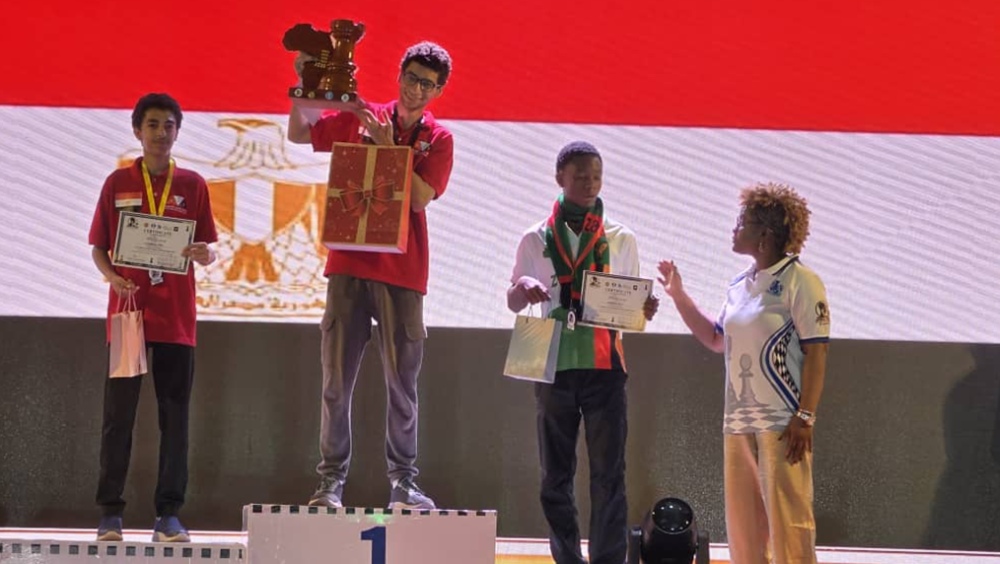
Egypt underlined their dominance on the continental youth chess scene after emerging as overall winners of the 17th Africa Youth Chess Championship held in Entebbe, Uganda. The Egyptian youngsters finished with an impressive haul of 11 medals: six gold, four silver, and one bronze. One of the biggest stories of the championship came in the Under-8 Open section, where 39th seed Sameir Mahmoud of Egypt defied all odds to clinch gold in sensational fashion, proving that rankings matter little once the clocks start ticking. Kenya’s Kirega Rayvon and Kariuki Matthias completed the podium with silver and bronze, respectively. The host nation, Uganda had reason to celebrate in the Under-8 Girls category after 30th seed Jacinta Mbabazi delivered a memorable performance to secure one of the country’s three gold medals. Mbabazi finished tied on 8/9 points with Kenya’s Jasmine Aaliyah before edging her out on tiebreaks, while South Africa’s Khethelo Mlaba claimed bronze – the country only medal at the championship. Top seed Tawfeik Said of Egypt justified her billing in the Under-10 Girls section after producing a dominant display to win gold with 8/9 points. Uganda continued their strong showing by securing both silver and bronze medals in the category. In the Under-10 Open, Egypt’s Ezaat Ahmed captured gold with 8.5 points as Kenya once again settled for silver and bronze. Kenya’s WCM Winnie Kaburo won the gold medal in the Under-12 Girls after finishing with an outstanding 8/9 points. Egypt’s Mohamed Ahmed claimed silver while Madagascar’s Nivo Tsinjovintavo made history for her nation by securing bronze. Uganda’s Ronald Wabwire thrilled the home crowd after scoring 8/9 points to clinch gold in the Under-12 Open section. The Kenyan pair Nathaniel Manyeki and Faraja Muli completed the podium with silver and bronze respectively. Madagascar’s Aina Tsinjovintavo caused one of the tournament’s biggest sensations after winning the Under-14 Girls title with eight points ahead of experienced campaigners Mohamed Ahmed Zaka and Juliet Asaba. In the Under-14 Open category, Egypt’s Mustafa Ahmed and Angola’s Nsimba Wela both finished tied on eight points, but superior tiebreaks handed Mustafa the gold medal. Zambia’s Twalumba Sianyinda completed the podium with bronze. Kenya’s WCM Elizabeth Cassidy Maina continued her remarkable rise after adding the Under-16 Girls crown to the Under-14 title she won in Zimbabwe last year. Meanwhile, sixth-seeded Alvin Muhirwa gave Uganda another reason to celebrate after emerging as champion in the Under-16 Open section with 7.5 points. Egypt’s Zaki Mohamed maintained her fine form to secure gold in the Under-18 Girls section ahead of former champion Omprakash Sana, while Kenya’s Bella Nashipae claimed bronze. The North Africans capped off a memorable championship by dominating the Under-18 Open section, where Ahmed Kandil and Eyad Elhusseiny secured gold and silver, respectively, with Kennedy Shane taking bronze. This year’s edition of the prestigious continental youth championship attracted more than 900 players from across Africa, with Kenya fielding the largest delegation at the tournament. Medal standings During the closing ceremony of the Africa Youth Chess Championship 2026 in Entebbe, Uganda, the African Chess Confederation delivered an unforgettable moment when it paused the celebrations of Africa’s rising chess stars to pay tribute to the legends who built the foundation of Ugandan chess. In an emotional and heartfelt ceremony held as part of the ACC’s 50th anniversary commemorations, ACC President Tshepiso Lopang personally honoured the families of the founding members of the Uganda Chess Federation – pioneers whose vision, resilience, and sacrifices helped establish organised chess in Uganda long before the game enjoyed the continental recognition it has today. Awardees: PAUL BITARABEHO received posthumous award, he passed away in 1990, and he was the Chairperson of Uganda Chess Federation. DR YUSUF MPAIRWE received posthumous award, he was one of the founding members of Uganda Chess Federation. LAWRENCE KAPANGA received a posthumous award; he was the founding general Secretary of the Uganda Chess Federation. DANIEL NSIBAMBI received a certificate of recognition; he once served as the President of Uganda Chess Federation DAVID MUWANIKA received a certificate of recognition, he is a veteran chess administrator known not only in Uganda but across the continent. ALLAN MBABANI received a certificate of recognition, he is the founder of BANI CHESS BULLETIN an online media house that amplifies the coverage of chess not just in Uganda but across the continent. NEW VISION received a certificate of recognition for the role they have played in amplifying the coverage of chess in Uganda. NAMIBIA BROADCASTING CORPORATION received a certificate of recognition for the role they have played in amplifying the coverage of chess in Uganda. Text and photos: African Chess Confederation
Vincent Keymer wins Super Chess Classic Romania in breakthrough Grand Chess Tour debut

GM Vincent Keymer of Germany captured the title at the Super Chess Classic Romania, securing first place after defeating Jorden van Foreest in the only decisive game of the ninth and final round to avoid a playoff. The victory marks Keymer’s first tournament win in a classical event on the 2026 Grand Chess Tour (GCT) during his debut appearance as a full tour player. The 2026 Super Chess Classic Romania was a 10-player round robin, featuring nine full Tour players and one wildcard. Headlining the 2026 lineup were Fabiano Caruana, Alireza Firouzja, Wesley So, Vincent Keymer, Anish Giri, Praggnanandhaa Rameshbabu, Javokhir Sindarov, Maxime Vachier-Lagrave, and Jorden Van Foreest, joined by Romanian wildcard Bogdan-Daniel Deac. For this victory, Keymer earned a total of $131,250, which included his share of the $125,000 Classical Wins Bonus, distributed among players based on total wins across the tournament, with the prize pool divided by the number of games won to determine a per-win value and each player’s final bonus allocation. “Vincent’s performance in Bucharest was a tremendous example of the next generation of elite players rising to the occasion on one of chess’s biggest stages,” said Michael Khodarkovsky, Executive Director of the GCT. “It’s exciting to see new talent break through and claim a major title against such a world-class field, and we believe fans are witnessing the future of elite chess unfold in real time.” Fabiano Caruana finished in second place after remaining in contention for the title until the final round, while World Championship Challenger GM Javokhir Sindarov secured third place with another impressive performance against a world-class field. The event featured intense competition throughout the nine rounds, including the withdrawal of Alireza Firouzja, who stepped out of the tournament due to a persistent ankle injury. “Congratulations to Vincent Keymer for an extraordinary performance and a well-deserved title,” said Augusta Dragic, President of the Super Foundation. “We also extend our appreciation to all participants for the exceptional quality of play, sportsmanship, and dedication they demonstrated throughout the Super Chess Classic Romania, making it a true celebration of elite chess at its highest level.” 2026 Super Chess Classic Romania Final Standings 1 GM Keymer, Vincent 2759 6 2 GM Caruana, Fabiano 2788 5½ 3 GM Sindarov, Javokhir 2776 5 4 GM So, Wesley 2754 5 5 GM Van Foreest, Jorden 2735 4½ 6 GM Deac, Bogdan-Daniel 2650 4½ 7 GM Giri, Anish 2767 4½ 8 GM Praggnanandhaa, R 2733 4½ 9 GM Vachier-Lagrave, Maxime 2717 4½ 10 GM Firouzja, Alireza 2759 1 “I still haven’t fully taken in what happened – it’s been an amazing event for me,” said Keymer. “I’m very happy with my performance, especially despite a setback in the middle. This is the biggest tournament victory of my career so far. I prepared less and focused more on having enough mental energy to be successful. I want to thank the organizers of the Grand Chess Tour, my coach Peter, my father, and all the fans who supported and cheered for me.” The GCT now heads to Zagreb for Super Rapid & Blitz Croatia, taking place from June 29 to July 6, 2026. As the second rapid and blitz event of the tour, the tournament will feature a total prize fund of $200,000 and include six full-tour participants alongside four wildcard players: Gukesh Dommaraju of India, Nodirbek Abdusattorov of Uzbekistan, Bogdan-Daniel Deac of Romania, and Ivan Saric of Croatia. Text: Grand Chess Tour Photos: Grand Chess Tour / Lennart Ootes
European Chess for Freedom Workshop explores rehabilitation through chess in Teramo

The European “Chess for Freedom” workshop took place in Teramo, Italy, from May 17 to 19, bringing together prison administrators, educators, chess officials, researchers, and social project coordinators to explore the growing role of chess in rehabilitation, reintegration and social inclusion. Organised with the support of the Italian Chess Federation (FSI), the TERCAS Foundation, and the FIDE Social Commission, the event combined conference sessions, project presentations, international case studies, and a visit to the Teramo prison, where delegates met inmates participating in the 2nd Continental Online Championship for Prisoners. 18 May: International Workshop The main conference day on May 18 was moderated by Antonio Amatulli, Secretary of the FSI Social Commission. Institutional greetings were delivered by Vincenzo Piero Di Felice, President of the TERCAS Foundation, followed by FSI President Luigi Maggi and Dana Reizniece, Deputy Chair of the FIDE Management Board. Rossana Ciuffetti, Director of the Scuola dello Sport – Sport e Salute, also addressed participants, while Italian Deputy Minister of Justice Senator Francesco Paolo Sisto joined remotely via video message. The morning session focused on the work of social chess commissions and prison initiatives. Mirko Trasciatti, coordinator of prison projects for the Italian Chess Federation, presented the work of the FSI Social Commission and its efforts to use chess as a tool for inclusion and reintegration. André Vögtlin, Chairman of the FIDE Social Commission, spoke about the wider impact of social chess initiatives and the role of chess mental models in social transformation. His presentation connected the “Chess for Freedom” initiative with broader educational and social objectives pursued by FIDE Social Chess. Other presentations included the Italian “Scacco al Tempo” prison project presented by Eulalia Caramanica, which combines chess and music as educational tools for inmates, as well as the Erasmus+ “ICARUS” initiative, presented by Antonia Castellani, CEO of Skill-Up, which uses chess to teach soft skills and support reintegration. The afternoon session turned toward international experiences within the “Chess for Freedom” movement. Patrizia Bruna Boccia, Head of the Educational and Treatment Area at Teramo Prison, opened the session before journalist and sports administrator Filippo Grassia joined the workshop remotely through Zoom and spoke about the cognitive and social benefits of chess. Stefania Di Padova, Councillor for Social Policies of Teramo, joined the afternoon session to bring the city’s greetings. Mikhail Korenman, coordinator of the “Chess for Freedom” program, presented the development of the initiative since its launch in 2021, including the first intercontinental online championship for prisoners and the expansion of prison chess programs worldwide. Korenman also presented research examining the impact of chess programs in correctional facilities. One study from Cook County explored how incarcerated participants associated chess with strategic thinking, patience, and decision-making in everyday life. Lāsma Kokoreviča of the Latvian Prison Administration presented Latvia’s evolving rehabilitation-oriented prison model and explained how meaningful activities such as chess programs help reduce tension, improve emotional regulation and strengthen communication skills inside prisons. Rodrigo Barbeito of Spain’s Club Magic shared the organisation’s long-running prison chess initiatives in Extremadura, including its participation in the first “Chess for Freedom” events and its international cooperation projects connected to ICARUS and FIDE initiatives. Augusto Caruso, an instructor working in Gorizia Prison, reflected on his personal experiences teaching chess inside correctional facilities. He described how chess lessons helped build trust, dialogue, and mutual respect between instructors and inmates. During the workshop, FSI President Luigi Maggi and prison project coordinator Mirko Trasciatti received the FIDE Outstanding Contribution Award in recognition of their work promoting social chess initiatives and prison programs in Italy. 19 May: Prison Tournament & Cultural Visit On May 19, delegates visited Teramo Prison to interact with inmates playing in the 2nd Continental Online Championship for Prisoners (Europe). The tournament created what organisers described as a highly educational and emotional atmosphere, with inmates fully engaged in the competition. Games took place on chess.com, featuring a rapid time control of 10 minutes with a 5-second increment. Italy finished the event with three wins and four losses, placing 17th out of 31 teams. Ukraine topped the standings, winning all of its matches. Following the prison visit, delegates visited the TERCAS Foundation headquarters at Palazzo Melatino, home to the Civic Museum of Teramo. During the visit, Dana Reizniece presented the official FIDE book as a gift for TERCAS Foundation President Piero Di Felice (who was absent due to work duties). “Chess has a unique ability to create dialogue, responsibility and hope, even in the most difficult environments,” said Dana Reizniece. “The workshop in Teramo showed how prison chess initiatives are growing across Europe, bringing together educators, prison authorities and chess organisers who believe in rehabilitation through meaningful human connection. Seeing 20 countries represented in the European Chess for Freedom Championship, including new participants such as Belgium and Albania, was a strong reminder that this movement continues to expand and inspire.” The workshop ended with participants leaving Teramo with new ideas, stronger connections and a shared belief in the value of chess inside prisons. Across the discussions, presentations and prison visit, participants highlighted how chess can encourage discipline, and personal growth while creating opportunities for education and reintegration beyond prison walls. About Chess for Freedom The Chess for Freedom initiative was launched by FIDE in partnership with correctional institutions around the world to make chess accessible to inmates as an educational and social tool. It promotes critical thinking, emotional control, and teamwork, helping participants gain valuable skills for reintegration into society. Since the first Intercontinental Championship in 2021, the project has grown into a global movement. Thousands of inmates have taken part in regional and international tournaments, workshops, and educational programs across six continents. The 2025 edition, the largest so far, brought together 135 teams from 57 countries. It reflects the unifying message of the Chess for Freedom initiative: chess transcends walls, borders, and circumstances, offering a bridge to learning, reflection, and hope.
Xu Xiangyu and Yan Tianqi win Chinese national titles, earn Chess Olympiad spots
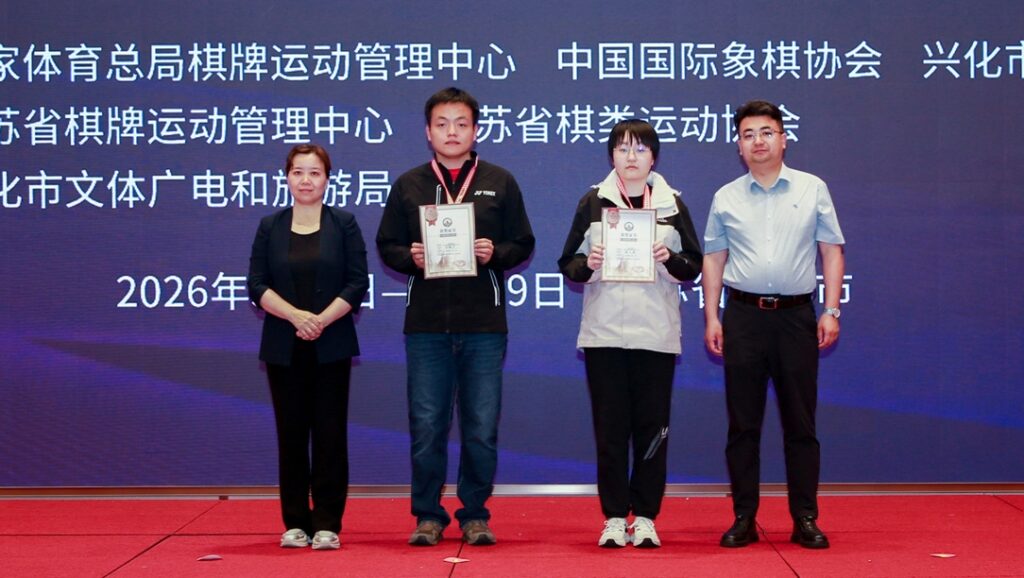
The 2026 Chinese National Individual Chess Championship took place in Xinghua, Jiangsu from 7-18 May, featuring separate Open and Women’s sections. After 11 rounds of Swiss play, GM Xu Xiangyu and WIM Yan Tianqi emerged victorious to claim their first national titles and secure spots on the Chinese team for the upcoming 46th Chess Olympiad. Xinghua is no stranger to chess fans – it’s the hometown of long-time world No. 1 women’s player and four-time women’s world champion Hou Yifan. This year marked the 18th consecutive edition hosted by the city since 2009, and the second year the event has used an 11-round Swiss format instead of the traditional round-robin. The total prize fund amounted to 500,000 RMB (approximately 73,500 USD), with the men’s champion receiving 120,000 RMB and the women’s champion 80,000 RMB. Open event The open section featured 66 players, including nine Grandmasters. The competition was tightly contested, with a sole leader – 17-year-old IM Kong Xiangrui – emerging only after Round 8. Top seed GM Xu Xiangyu caught up with him in Round 9, and the pair entered the final round tied on 7.5 points. Xu defeated GM Li Di while Kong had to work hard in a difficult position to salvage a draw against IM Lou Yiping. Xu Xiangyu scored 8.5 points (6 wins, 5 draws) and secured the title – his fist national crown after finishing second in 2023 and third in both 2022 and 2024. This victory also earns him a debut on China’s Olympiad team later this year. Kong Xiangrui and GM Xu Yinglun tied for second place on 8 points. Kong took silver for the second year in a row on tie-break, while Xu Yinglun completed the podium. With a performance rating of 2604, Kong earned his first GM norm. Another teenager, 15-year-old Xie Jiaxiang, secured an IM norm. Final Standing – Open: https://chess-results.com/tnr1389458.aspx Women’s event In the women’s section, 24-year-old WIM Yan Tianqi totaled 8.5 points (7 wins, 3 draws, 1 loss) to win her first national title. Like Xu Xiangyu, she earned a berth on the Chinese Olympiad team – also her first. Yan Tianqi entered the event with two WGM norms and delivered a performance rating of 2416, but fell short of her last WGM due to insufficient games against WGMs. 17-year-old WIM Chen Yining claimed silver with 8 points, while 15-year-old WIM Wang Qinxuanyi took bronze with 7.5 points. Top seed WGM Xiao Yiyi also scored 7.5 but finished fourth on tie-breaks. Chen Yining earned a 9-game WGM norm, Bai Xue got an 11-game WIM norm, and both Jiang Tianyu and Wang Xiaoyan completed 10-game WIM norms. Final Standing – Women: https://chess-results.com/tnr1389459.aspx Text and photos: Liang Ziming
Chess boards from the 46th FIDE Olympiad to find new homes across the world
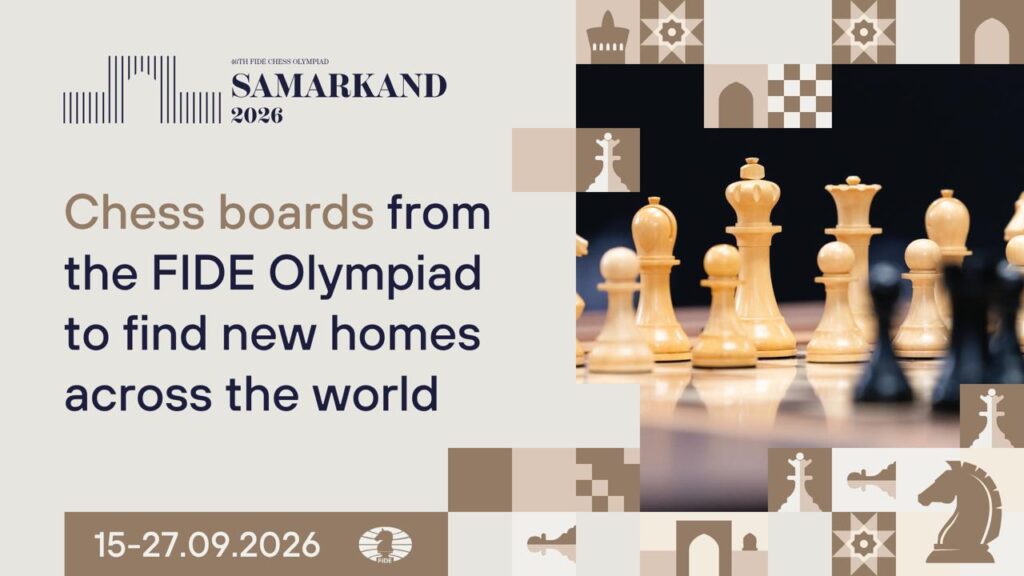
The boards from the 46th FIDE Chess Olympiad in Samarkand will be distributed to national federations after the event, leaving a piece of the world’s biggest chess festival with the global community long after the final round is played. Every two years, the Chess Olympiad brings together thousands of players from across the globe, competing on the same boards, in the same halls, under the same pressure that defines the sport at its highest level. When the 46th Chess Olympiad concludes in Samarkand, Uzbekistan, the boards played on throughout the event will not disappear into storage. Instead, they will continue their journey in federations and tournaments around the world. Around 900 DGT boards that will be distributed are not replicas or souvenirs produced for the occasion. They are the very same electronic boards on which the world’s strongest national teams will have competed across eleven rounds of the Open and Women’s sections of the Olympiad. For the federations that receive them, they will remain practical tournament equipment while also carrying the history of the games played on them. FIDE President Arkady Dvorkovich welcomed the initiative: “The Chess Olympiad brings together the entire chess world, and these boards will carry that spirit into federations across every continent. These boards symbolize the very spirit of Gens Una Sumus but, no less importantly, will provide an important practical solution for many federations.” Federations wishing to receive electronic boards from the 46th Chess Olympiad are invited to submit a request by email to gsc@fide.com, indicating the number of boards they would like to receive.
2nd World Youth Chess Solving Championship: Registration now open
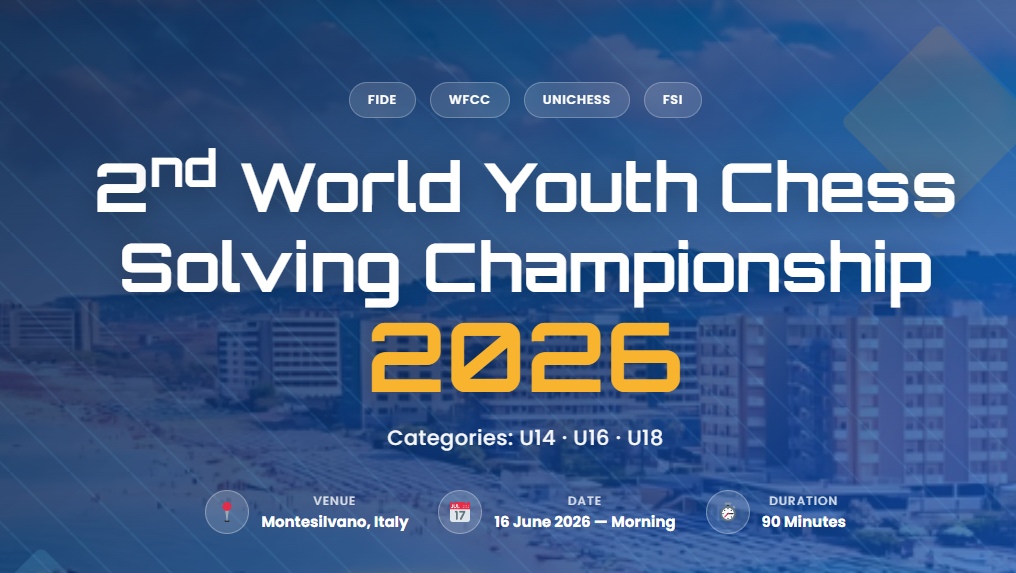
FIDE and the World Federation for Chess Composition (WFCC), together with the Italian Chess Federation and UniChess, are pleased to announce the 2nd World Youth Chess Solving Championship 2026. The event will be held in Montesilvano, Italy, on June 16, 2026, starting at 10:00 local time. The competition will take place between the 1st and 2nd rounds of the World Youth Chess Championship (WYCC) 2026, sharing the same age categories as the over-the-board tournaments: under 14, under 16 and under 18. There will be separate rankings for Open and Girls. Girls may choose to compete in the Open category by notifying the organizers before the tournament. Solving format Each category will solve a different set of 8 problems, including: 3 problems in 2 moves 2 problems in 3 moves 1 problem in 4 moves 2 endgames Time allowed: 90 minutes Official information: Date: June 16, 2026 Location: Montesilvano, Italy (venue same as WYCC-2026) Regulations (PDF) Registration form: https://form.jotform.com/FCCC/WYSC-2026 Participation fee: €25 per person Additional info: Marjan KOVAČEVIĆ WFC President, +381621792972 E-mail: president@wfcc.ch Official website: https://www.chessworldyouth.com/world-youth-chess-solving-championships/
Chess superstars headline a packed World Team Rapid and Blitz Championships in Hong Kong

By Milan Dinic With less than a month to go to the biggest World Rapid and Blitz team event, the lineups have been revealed. Altogether, 43 teams and more than 300 players are confirmed for the fourth edition of the WTRB. The leading teams from previous editions, WR Chess, Hexamind, and Team MGD1, all return with stellar lineups. But Hong Kong will also feature notable newcomers, including the all-Chinese Dragon Chilling squad led by Ding Liren. WR will be the most eye-catching team in Hong Kong and the top favourites for the first spot, having won the inaugural Rapid Championship in 2023 and the Blitz events in 2024 and 2025. Their biggest asset is Magnus Carlsen – currently the only 2800-rated player in the world. Featuring Fabiano Caruana, Maxime Vachier-Lagrave, Wesley So, Jan-Krzysztof Duda, Hou Yifan, and Alexandra Kosteniuk, the lineup resembles a list of top-rated players in the world. WR’s biggest rivals by rating are Hexamind, with elite players such as Levon Aronian, Anish Giri, Alireza Firouzja, Vidit Gujrathi, Kateryna Lagno, and – the 2024 World Rapid Champion Volodar Murzin. In 2025, they took silver in the Rapid and bronze in the Blitz in London. Another big contender will be India’s Team MGD1, who has been one of the most consistent sides in the World Rapid and Blitz Teams. In 2023 they took the bronze in Rapid, took silver in the Blitz in 2024 and then won the 2025 World Rapid Team title in London, with 21 match points from 12 rounds. Bringing the core of India’s new generation, the team features some of the most notable young names in chess today – Arjun Erigaisi, Nihal Sarin, Pranav V, Leon Luke Mendonca, as well as Harika Dronavalli. Another notable Indian-rooted squad in Hong Kong is Chessgurukul. Their lineup includes super-strong young Indian GMs such as Praggnanandhaa R, Aravindh Chithambaram, Vaishali Rameshbabu, and Pranesh M. Built around players closely linked to the Chess Gurukul school and to RB Ramesh’s wider influence on Indian chess, this team can spring a surprise in any match and should be closely watched. Dragon Chilling has one of the most attractive national-style lineups, led by Ding Liren, Wei Yi, Yu Yangyi, Ju Wenjun, and Lei Tingjie. The biggest news is the return of former World Champion Ding Liren, who has largely retreated from the chess world after his loss to Gukesh in the 2024 match for the world crown. The World Rapid and Blitz Teams in Hong Kong will be the first time since 2024 that Ding plays in a major international event with super-elite players. Another team from Asia – with a strong track record in the WRBT – is Kazchess, standing out with the heavyweights such as Shakhriyar Mamedyarov, Alexander Grischuk, Richard Rapport, Wang Hao (the winner of the inaugural Grand Swiss, in 2019), Bibisara Assaubayeva, and Kazybek Nogerbek. Uzbekistan has a very serious squad built around Nodirbek Abdusattorov, World Championship Challenger Javokhir Sindarov, as well as their top players Nodirbek Yakubboev, Shamsiddin Vokhidov, and one of the top players from the early 2000s and former FIDE World Champion, Rustam Kasimdzhanov. Chess United are especially notable because of Viswanathan Anand, Humpy Koneru, Jorden van Foreest, and – the recently confirmed second youngest GM in chess history – Faustino Oro. Endgame.AI should not be overlooked either, with Hans Niemann, Leinier Dominguez, Amin Tabatabaei, Alexey Sarana, Denis Lazavik, and Zhu Jiner. The fast chess quality is also very high. Most of the top players of FIDE’s May 2026 Blitz ranking appear in this approved list, with Carlsen, Firouzja, Arjun, Artemiev, Vachier-Lagrave, Aronian, Anand, and Caruana all present. WR Chess is the glamour team of the 2026 WRB Teams event, but several rival squads have enough star power to challenge them. The fact that teams have to include not only pros but also recreational players whose performance can vary makes it hard to predict anything but a big show in Hong Kong. The full list of teams and lineups is available on the event website: Registered teams About the Hong Kong WTRBC edition The 2026 edition will take place in Hong Kong during the event week of 16 to 22 June. The competition days are scheduled for 17 to 21 June at Queen Elizabeth Stadium. Rapid will be played as a Swiss event over 12 rounds from 17 to 19 June, with a time control of 15 minutes plus 10 seconds per move. Blitz follows on 20 and 21 June, beginning with pools before a 16 team knockout. The blitz time control is 3 minutes plus 2 seconds. The total prize fund is €500,000. Rapid receives €310,000, while blitz receives €190,000. The rapid champions will earn €110,000, and the blitz champions €75,000. The other major addition is the inaugural FIDE World Team Amateur Rapid Chess Cup, which will run alongside the main championship. That gives the 2026 edition a broader festival shape and reinforces the event’s central idea of bringing elite and amateur chess closer together. About the Word Team Rapid & Blitz Championships The FIDE World Team Rapid and Blitz Championships began in 2023 in Düsseldorf. The first edition featured rapid chess only. Blitz was added in 2024, turning it into the current two-title event. Three editions have been completed so far, in Düsseldorf, Astana, and London. Hong Kong 2026 will be the fourth. Clubs, companies, federations, and independent groups to enter the competition. Every match is played over six boards. Each team must include at least one female player and at least one recreational player, defined as someone who has never reached a FIDE rating of 2000 in standard, rapid, or blitz. The rapid title was won by WR Chess in 2023, Al-Ain ACMG UAE in 2024, and Team MGD1 in 2025. Blitz was added to the programme in 2024. WR Chess won that title in both 2024 and 2025.
Giovanni Longo International Chess Museum opens in Marostica, Italy
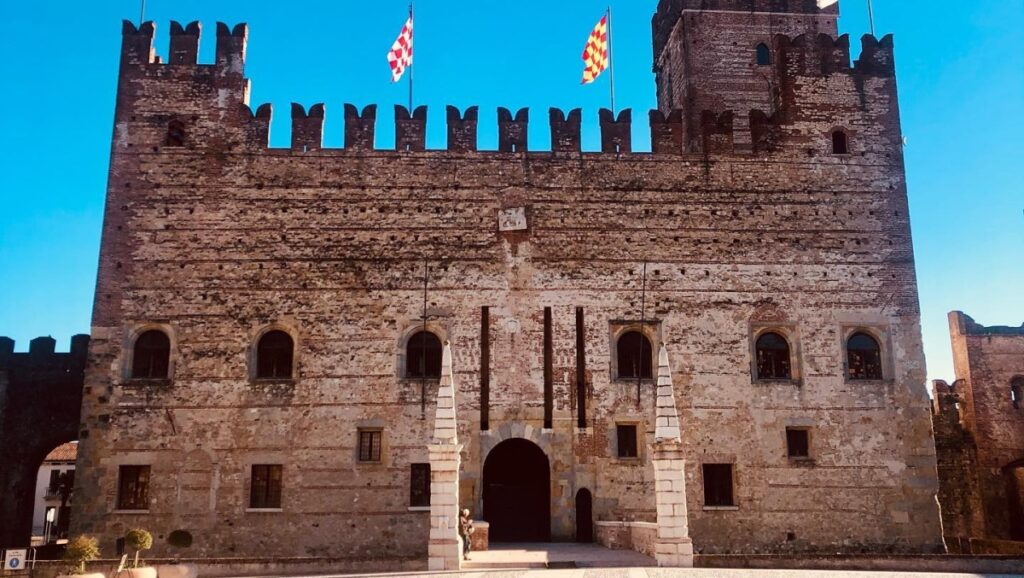
The Giovanni Longo International Chess Museum – City of Marostica officially opened its doors on May 16 in Marostica, in the province of Vicenza, Veneto. The museum is located in the 14th-century Lower Castle, overlooking the city’s famous Chess Square, internationally renowned for the “Living Chess Game” staged every two years in autumn. It is the first museum of its kind in Italy and one of the very few dedicated chess museums in Europe. The museum was established thanks to a donation by Giovanni Longo, a distinguished collector who wished to make the objects he gathered over the years accessible to the public. The exhibition features around 150 items, including 90 chess sets and boards, displayed in a modern exhibition space designed to be fully accessible to visually impaired and hearing-impaired visitors, with a free app serving as an audio guide. The collection is extended across four rooms dedicated to four continents – Europe, America, Asia, and Africa – and includes both antique and contemporary works of exceptional beauty and value. Among the highlights are giant chess sets created by the Milanese artist Enrico Baj, a chess set designed by Max Ernst, and many other remarkable masterpieces. Speakers at the inauguration included the Mayor of Marostica, Matteo Mozzo; Mara Bizzotto, Undersecretary at the Ministry of Enterprises and Made in Italy; Marco Zecchinato, Regional Councillor for Interregional Cooperation; and Luigi Maggi, President of the Italian Chess Federation (FSI). The guest of honor was Zurab Azmaiparashvili, President of the European Chess Union, who congratulated both the city and the Italian chess community on this extraordinary achievement. “The works come from all over the world,” explained donor Giovanni Longo, “and trace a journey through the centuries, from the 18th century to the present day, beginning with Chinese and Indian craftsmanship and arriving at contemporary interpretations of the game of chess. The exhibition includes chessboards and sets of every size, from miniature artifacts to monumental works measuring three by three meters, as well as sculptures, unique pieces, chess clocks, symbolic objects, and various curiosities.” “In this period of rapid growth for Italian chess,” added Maggi, “with the Federation reaching record numbers of members and affiliated clubs, we warmly welcome the opening of this Museum. It connects the present of this wonderful sport with its glorious past and gives Italy an exhibition space that highlights the inseparable bond between chess, art, and culture.”
Winners crowned at inaugural Turkic Nations Team Chess Championship
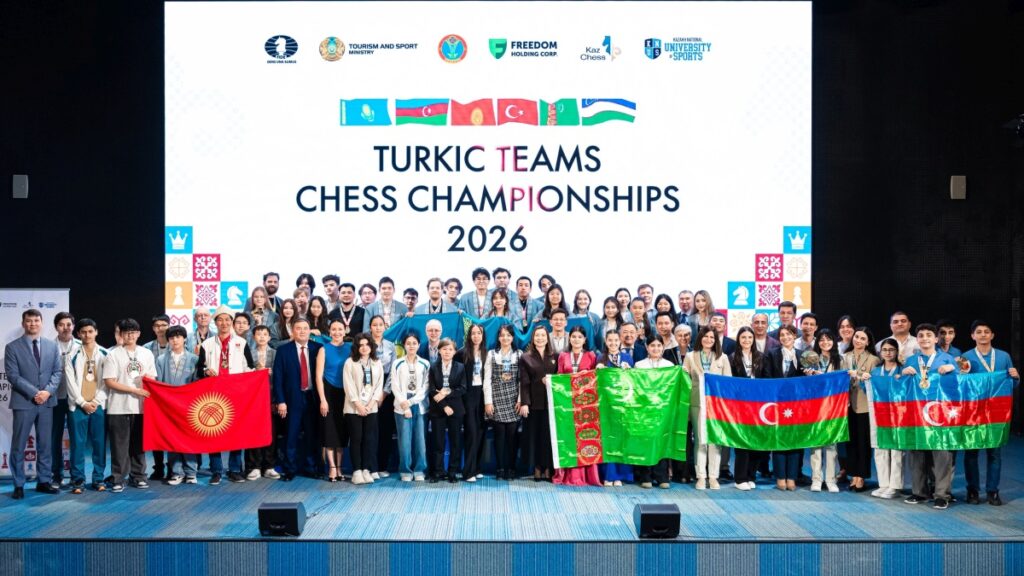
Astana stood at the crossroads of the Turkic world from May 14 to 17, 2026, capturing its significance across several domains. On the eve of the event, Turkish President Recep Tayyip Erdoğan paid a state visit to the capital of Kazakhstan at the invitation of Kazakh President Kassym-Jomart Tokayev. Concurrently, on May 15, Turkistan hosted an informal summit of the Organization of Turkic States dedicated to Artificial Intelligence and Digital Development. Against this backdrop, the Kazakh National University of Sports in Astana hosted two major chess events: the inaugural Turkic Open and Women’s Team Chess Championships 2026 and the Turkic Youth U16 Chess Olympiad 2026. Timur Turlov, President of the Kazakhstan Chess Federation, highlighted the significance of this coincidence: “Kazakhstan is the first in the region to host this new tournament for the Turkic world. It is highly symbolic that the event coincides with the visit of Turkish President Recep Tayyip Erdoğan to Astana. Under our President’s policy, Kazakhstan is consistently strengthening its position within the Turkic space, and chess is becoming a prominent tool of this diplomacy. It is no longer just a sport, but a vital element of friendship between our nations.” Serik Zharasbayev, Vice Minister of Tourism and Sports of the Republic of Kazakhstan, extended a warm welcome to the audience at the opening ceremony: “On behalf of the Ministry of Tourism and Sports, I would like to thank all the participants and heads of delegations for joining us. I also want to personally thank Timur Turlov for his immense contribution as President of the Kazakhstan Chess Federation. We are already seeing the fruits of this labor. Today, we have world-class players achieving great success on the international stage—talents like Kazybek Nogerbek and Bibisara Assaubayeva, who made history as our country’s first three-time World Rapid Champion. This is a monumental achievement. I wish everyone continued success. Onward to new heights and great victories!” In each of the three categories (Open, Women, and Youth U16), seven national teams competed in a round-robin system. The participating nations were Azerbaijan, Kyrgyzstan, Turkmenistan, Turkey, Uzbekistan, and Kazakhstan, with the latter fielding two teams in each tournament as the host nation. Each team line-up consisted of four main players, one reserve, and a captain. The competitions used the new classical 45+30 format, allocating 45 minutes per game with a 30-second increment for every move. The guaranteed prize fund amounted to 27 million tenge (approximately 54,000 US dollars). The event was organized by FIDE, the Ministry of Tourism and Sports of the Republic of Kazakhstan, the Kazakhstan Chess Federation (KazChess), the Kazakh National University of Sports, and the Akimat of Astana. Freedom Holding Corp. served as the General Partner of the championship. The Open Championship The open tournament brought together 13 Grandmasters and 18 International Masters. The battle for the title lasted until the last moments of the final round. The national team of Kyrgyzstan delivered the biggest upset of the final round by defeating the higher-rated Uzbek team with a score of 3-1, remaining undefeated on every single board. This result largely shaped the final standings: both Kazakhstan-2 and Kazakhstan-1 won their respective final matches to ascend to the top of the standings, followed by Azerbaijan. Final Standings (Turkic Open Team Chess Championships 2026): Kazakhstan-2: 9 match points, 13½ board points (Prize: 5 million tenge, approximately $10,000) Kazakhstan-1: 8 match points, 13 board points (Prize: 3.5 million tenge, approximately $7,000) Azerbaijan: 7 match points, 14½ board points (Prize: 2 million tenge, approximately $4,000) Uzbekistan: 7 match points, 12½ board points Turkey: 5 match points, 12 board points Kyrgyzstan: 5 match points, 9½ board points Turkmenistan: 1 match point, 9 board points Best Individual Board Results: Board 1: 1. IM Zhandos Agmanov (Kazakhstan-2, 4½ points); 2. GM Ahmad Ahmadzada (Azerbaijan, 4 points); 3. GM Saparmyrat Atabayev (Turkmenistan, 3½ points). Board 2: 1. GM Denis Makhnev (Kazakhstan-1, 4 points); 2. GM Ramazan Zhalmakhanov (Kazakhstan-2, 3½ points); 3. GM Misratdin Iskandarov (Azerbaijan, 3½ points). Board 3: 1. IM Aldiyar Ansat (Kazakhstan-1, 4 points); 2. IM Arda Camlar (Turkey, 3 points); 3. IM Satbek Akhmedinov (Kazakhstan-2, 3 points). Board 4: 1. IM Tologontegin Semetey (Kyrgyzstan, 3½ points); 2. IM Saidakbar Saydaliev (Uzbekistan, 3½ points); 3. IM Shiroglan Talibov (Azerbaijan, 2½ points). Board 5: 1. IM Murad Ibrahimli (Azerbaijan, 3½ points); 2. IM Umut Ata Akbas (Turkey, 3½ points). The Women’s Championship The Women’s tournament featured six International Masters, five Woman Grandmasters, and five Woman International Masters. The national team of Azerbaijan entered as the clear favorite, fielding the exact same powerhouse line-up that secured the silver medal at the 2025 World Team Chess Championship with IM Ulviyya Fataliyeva (2450, ranked world No. 25 in the FIDE standings) and IM Gunay Mammadzada (2374) on first and second boards, respectively. Uzbekistan’s formidable roster included WGM Afruza Khamdamova (2423, ranked world No. 34 in the FIDE standings) and WGM Umida Omonova (2357). The women’s competition was equally exciting, with Azerbaijan and Uzbekistan pitted against each other in the final round. Azerbaijan, having a two-point advantage, secured a draw against Uzbekistan to successfully defend their first-place position. Meanwhile, the Kazakhstan-1 team delivered a dominant 3½–½ victory over Turkmenistan to leapfrog Uzbekistan and claim the silver spot on the podium. Final Standings (Turkic Women’s Team Chess Championship 2026): Azerbaijan: 10 match points, 18½ board points (Prize: 5 million tenge, approximately $10,000) Kazakhstan-1: 9 match points, 16½ board points (Prize: 3.5 million tenge, approximately $7,000) Uzbekistan: 8 match points, 15½ board points (Prize: 2 million tenge, approximately $4,000) Kazakhstan-2: 6 match points, 13 board points Turkmenistan: 6 match points, 11 board points Kyrgyzstan: 2 match points, 4½ board points Turkey: 1 match point, 5 board points Best individual board results: Board 1: 1. WGM Afruza Khamdamova (Uzbekistan, 4½ points); 2. WGM Liya Kurmangaliyeva (Kazakhstan-2, 4 points); 3. WFM Lala Shokhradova (Turkmenistan, 3½ points). Board 2: 1. IM Meruert Kamalidenova (Kazakhstan-1, 5½ points); 2. WGM Umida Omonova (Uzbekistan, 3½ points); 3. WIM Assel Serikbay (Kazakhstan-2, 3 points). Board 3: 1. WGM Govhar