

Moldovan Championship: Lashkin and Mihailova come out on top
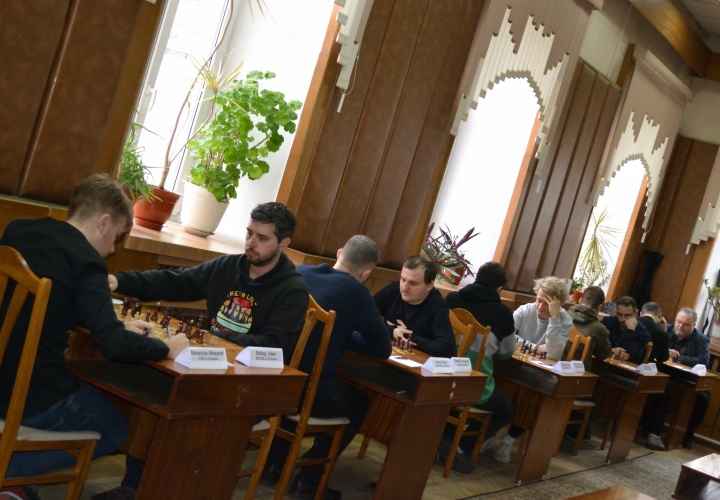
FM Jegor Lashkin and WFM Alina Mihailova are the new champions of Moldova. Both won their maiden titles in impressive style dominating the field. Both open and women’s sections of Moldovan championship 10-player round-robins with classical time control took place from February 02-12 in the country’s capital Chisinau. Jegor Lashkin (pictured above) steamrolled the competition in the open tournament conceding his opponents just a half point and finishing two points ahead of the rating favourite GM Vladimir Hamitevici, who claimed silver. IMs Ilia Martinovici and Ruslan Soltanici netted 5.5/9 each and tied for third place, with the former taking bronze thanks to the victory in the direct encounter. Final standings: 1 FM Lashkin, Jegor 2416 8½ 2 GM Hamitevici, Vladimir 2499 6½ 3 IM Martinovici, Ilia 2420 5½ 4 IM Soltanici, Ruslan 2356 5½ 5 GM Sanduleac, Vasile 2403 4 6 FM Ogleznev, Alexandr 2357 4 7 IM Baltag, Iulian 2433 3½ 8 Baranciuc, Alexandr 2163 3½ 9 FM Vavric, Pavel 2336 2½ 10 Eletskikh, Alexandr 2269 1½ Alina Mihailova (pictured below) from Comrat put in an even more dominating performance in the women’s championship, winning all nine games. Victoria Bargan scored a solid 7.5/9 (usually enough for first place in any competition, but not this one) and took silver. Ana Penticenco came in third. Final standings: 1 WFM Mihailova, Alina 1969 9 2 Bargan, Victoria 1784 7½ 3 WFM Petricenco, Ana 1832 6½ 4 Chendighilean, Anna 1462 6 5 Comarnitcaia, Ecaterina 1404 4 6 Dulteva, Anastasia 1485 4 7 Bitca, Emilia 1481 3 8 Laricov, Vlada 1167 2½ 9 Dabija, Paula 1271 2 10 Cazacu, Raluca-Cristiana 1279 0½ Photo: Federația de Șah a Republicii Moldova Facebook page Official website: sahmoldova.md/
Azerbaijan Women’s Championship: Govhar Beydullayeva defends title
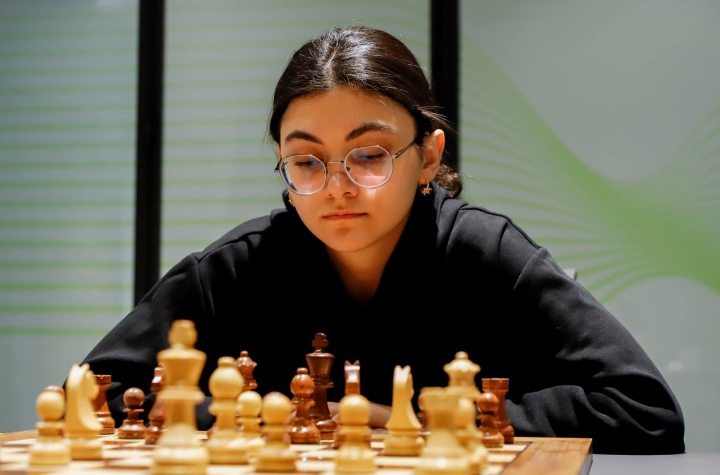
WGM Govhar Beydullayeva (pictured above) emerged as the 2023 Azerbaijan Women’s Championship winner, successfully defending her title. The Azerbaijan Women’s Championship took place in Baku from February 03-14, 2023, with 11 participants competing in a round-robin. After a discouraging start – the defending champion fell to WGM Khanim Balajayeva (pictured below) in the first-round encounter – Govhar reeled off five straight wins and joined the leaders. In the end, it all came down to the final round, to which Beydullayeva and Balajayeva headed, sharing the top position. Govhar scored a crucial victory over Turkan Mamedjarova and lifted the trophy as her main competitor managed only a draw against Narmin Abdinova and had to settle for silver. Khanim Balajayeva became the only player to defeat the champion and complete the tournament unbeaten. Despite losing three games, Sabina Ibrahimova netted 6.5/10 and finished third. Final standings: 1 WGM Beydullayeva, Govhar 2387 7½ 2 WGM Balajayeva, Khanim 2379 7 3 WIM Ibrahimova, Sabina 2174 6½ 4 Abdinova, Narmin 1932 6 5 WGM Abdulla, Khayala 2220 5½ 6 IM Mammadova, Gulnar 2376 5½ 7 WFM Allahverdiyeva, Ayan 2060 5 8 WGM Mamedjarova, Turkan 2244 5 9 WFM Hajiyeva, Laman 2135 3½ 10 WGM Mamedjarova, Zeinab 2249 2 11 Nuriyeva, Nurtan 1809 1½ Photo: Ceyhun Zeynalov Official website: asf.org.az/
FIDE joins the Sport Integrity Global Alliance

Last week, at its General Assembly, the Sport Integrity Global Alliance (SIGA) unanimously approved FIDE’s application to become a full member of the organization. SIGA is an independent not-for-profit that was founded with one goal: To ensure the sports industry is governed under the highest integrity standards, free from any form of unethical, illicit, and criminal activity, safeguarding sports values and ensuring its positive impact and benefits to all citizens. “Joining such a prestigious sports organization as a member is an excellent opportunity to improve even further FIDE’s governance. This opportunity is also a challenge: while much progress has been made in recent years, we can make FIDE a more robust organization under SIGA’s guidance and scrutiny, as they have the highest standards in the industry of sports”, said the FIDE President, Arkady Dvorkovich. “We are grateful that our membership has been unanimously approved at their General Assembly, and we will do our utmost to comply with their requirements”, he added. Founded in 2017 by 20 major sports organizations (sports bodies, governments, anti-corruption NGOs, inter-governmental organizations, and commercial partners), today, SIGA is the largest independent and neutral multi-stakeholder coalition in sports governance and integrity. With over 100 members, committed supporters and partners from the world of sport, government, international organizations, business, and civil society, SIGA pursues a critical mission: to advance the adoption, implementation, monitoring and independent assessment of Universal Standards on Sports Integrity in four key areas: Good Governance in Sport; Financial Integrity and Transparency in Sport; Sports Betting Integrity; and Youth Development and Protection. SIGA delivers independent global rating and certification for world Sport to ensure it is governed and operates under the highest integrity standards: The SIGA Universal Standards. Besides that, the establishment of SIGA’s Independent Rating and Verification System (SIRVS), operated by an independent third party, oversees the implementation of key reforms is the game changer that will give those that invest in sport certainty that the sports properties they support in are governed to the highest integrity standards. About SIGA: https://siga-sport.com/faqs/ Membership benefits: https://siga-sport.com/membership-benefits/
Elier Miranda wins 2023 Cuban Championship
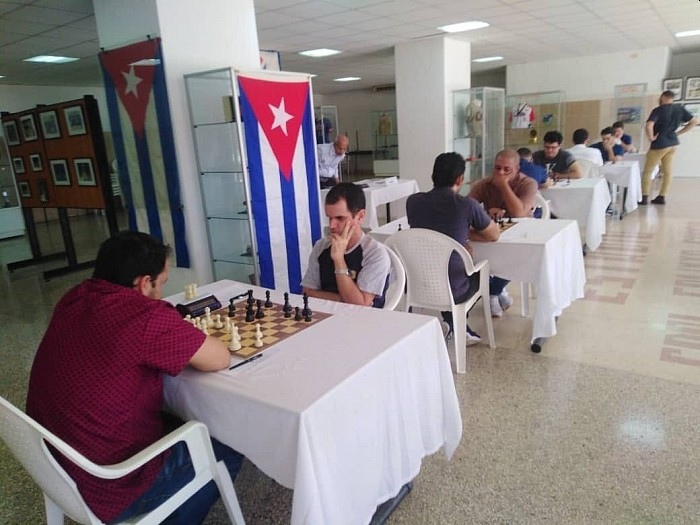
GM Elier Miranda is the new champion of Cuba. A total of 12 chess players, representing seven provinces, participated in the National Absolute Championship, which took place at the Sports Museum in the city of Holguin from February 02-12, 2023. The 2022 champion, Yasser Quesada, skipped the 2023 edition. With most of the participants closely rated, one could expect a very competitive 12-player round-robin, and indeed, it was the case. Heading into the final 11th round, Elier Miranda and GM Lelys Stanley Martinez were jointly leading the field with 7/11, a half-point ahead of GMs Carlos Daniel Albornoz and Luis Ernesto Quesada. Elier scored a crucial victory over Havana’s Omar Almeida on the white side of Pirc Defence, while his main competitor managed only a draw against Dylan Berdayes. With these results, Elier Miranda clinched his maiden national title and became the seventh Villa Clara player to win this tournament. Photo: http://ahora.cu/ Elier Miranda (pictured above) joined the legendary Guillermo García (1974 and 1983), Guillermo Estévez (1975), Jesús Nogueiras (1984, 1991 and 2000), Rodney Pérez (1999), Yuniesky Quesada (2008) and Yasser Quesada (2022). Carlos Daniel Albornoz and Luis Ernesto Quesada also notched up victories in the final round and caught up with Lelys Stanley Martinez, but the latter took silver thanks to superior tiebreaks. The runner-up became the only player to beat the champion and complete the event undefeated. Final standings: 1 Miranda Mesa, Elier GM 2486 8 2 Martinez Duany, Lelys Stanley GM 2507 7½ 3 Albornoz Cabrera, Carlos Daniel GM 2576 7½ 4 Quesada Perez, Luis Ernesto GM 2551 7½ 5 Soto Hernandez, Henry IM 2483 6 6 Almeida Quintana, Omar GM 2531 5½ 7 Berdayes Ason, Dylan Isidro IM 2505 5½ 8 Ortiz Suarez, Isan Reynaldo GM 2521 5 9 Fernandez Cardoso, Alexey IM 2438 4 10 Diaz Murgada, Rider IM 2441 4 11 Espinosa Veloz, Ermes GM 2500 3½ 12 Perez Leiva, Jerzy Jesus FM 2393 2 Photo: https://supercubadatabase.simdif.com and http://ahora.cu/
Alexandra Kosteniuk wins Women’s Grand Prix Munich
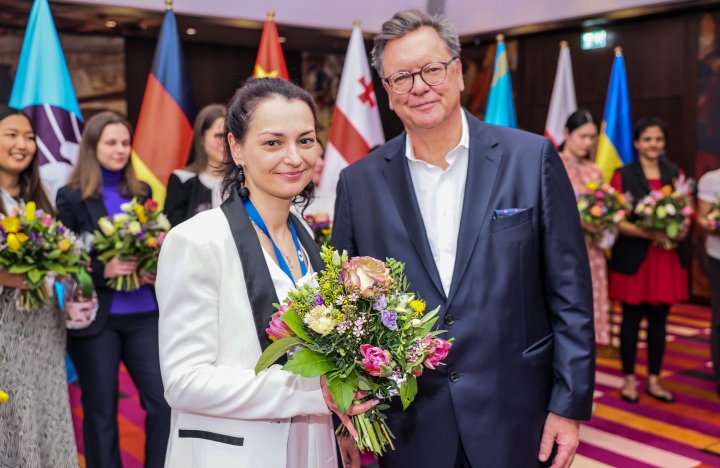
By IM Michael Rahal (Munich, Germany) Despite losing to Chinese phenomenon Zhu Jiner, former Women’s World Champion and winner of the 2021 World Cup Alexandra Kosteniuk added another tournament victory to her list of achievements by winning the Munich International Tournament this afternoon, the second event of the 2022-2023 FIDE Women’s Grand Prix. In addition to the €15,000 first prize, Kosteniuk will leave Germany with 160 Grand Prix points. However, it hasn’t been a bed of roses. Kosteniuk recognized that she was not very happy with her performance in many of the games, despite having scored very well. Luck has been on her side in several games: for example, she was completely lost yesterday against her immediate pursuer Humpy Koneru. India’s top female had a last chance to catch up with the “Chess Queen” by defeating Tan Zhongyi, but she was unable to overcome her opponent’s solid defensive play. The bronze medal goes to top Georgian Grand Master Nana Dzagnidze, after an excellent performance of three wins and only one defeat. Ullrich Krause, President of the German Chess Federation (pictured above) and Alojzije Jankovic, Vice President of the European Chess Union (pictured below), performed the ceremonial first moves of the final round in the games Kashlinskaya vs Paehtz and Zhu Jiner vs Kosteniuk, respectively. GM Dzagnidze, Nana vs GM Harika, Dronavalli (0.5-0.5) The first game to finish in less than half an hour. Dzagnidze and Harika played a theoretical line of the Semi-Tarrasch Queen’s Gambit and called it a day after a totally unforced threefold move repetition. With this result, both of them finish in the top half of the standings, gaining a few rating points. Additionally, Harika has finished the tournament undefeated, albeit with only one win. GM Muzychuk, Anna vs GM Abdumalik, Zhansaya (0.5-0.5) A few minutes later, a second game ended. Playing with Black, Abdumalik was content to accept a threefold move repetition in a very quiet Four Knights Opening. She finished the tournament with a solid 50% score, quite a good performance after beginning with 0.5/3. After three consecutive defeats, Anna Muzychuk draws the last game for a modest final result of 4/11, losing around 18 rating points. She will return to the board in the third event in Delhi (India) with extra motivation to go for a good result. GM Koneru, Humpy vs GM Tan, Zhongyi (0.5-0.5) In an ultra-solid Neo-Grunfeld Opening, Tan Zhongyi equalized comfortably out of the opening. After breaking up the position with 15…e5, the queens were exchanged and Humpy went into the ending with a passed c-pawn. Things were looking good, but she had used up most of her time. Nonetheless, the engines were suggesting that Black could happily keep the balance with precise play. Humpy was even able to win the exchange, but in the end, accepted her opponent’s draw offer in an equal position. With this result, Tan Zhongyi finishes on 50% with a very small rating loss, while Humpy Koneru scores an undefeated +2600 performance for the silver medal. Additionally, she takes home 130 Grand Prix points in her attempt to qualify for the Women’s Candidates. IM Kashlinskaya, Alina vs GM Paehtz, Elisabeth (0.5-0.5) Paehtz went for the Schlecter system in the Slav defence, one of Gata Kamsky’s pet lines. She equalized comfortably but then went wrong with the thematic break 14…e5? Kashlinskaya could have achieved a clear advantage with 17.axb5 but instead played 17.Bf3 and the position was equal again. After subsequent exchanges, the game petered out into a draw. Elisabeth Paehtz finishes the event with a decent 50% score and a small rating gain, while Alina Kashlinskaya clocks in a slightly disappointing result of 4.5/11 and a small 8-point rating loss. GM Muzychuk, Mariya vs WGM Wagner, Dinara (0.5-0.5) Mariya Muzychuk wanted to finish the tournament with a win after her lackluster performance in the second half. In front of her was an ambitious Dinara Wagner, keen to continue her comeback after yesterday’s win. The game was a very solid line in the Bb5 Moscow variation of the Sicilian defence. For the most part, both players kept manoeuvring, with Black exchanging as many pieces as possible. Approaching time trouble, with less than ten minutes each for the last ten moves, it was anybody’s game. Suddenly Dinara Wagner offered a draw which was accepted by Muzychuk: the situation is approximately equal, although there is still a lot of play in the position. Although finishing last in the event, Dinara Wagner only slightly underperformed with respect to her rating (-5 points), while Mariya Muzychuk will not be completely happy with her performance of 5/11, slightly below expectation. WGM Zhu, Jiner vs GM Kosteniuk, Alexandra (1-0) Although a draw would be enough for Zhu Jiner to make her International Master norm, her win against Kosteniuk today could have created a huge last-round upset. The game began with a complicated Nimzo-Indian variation. The position remained balanced, very strategic, for most of the game until Kosteniuk blundered with 27…Naxc4? Zhu Jiner recaptured with 28.Rxc4! and won two pieces for a rook. From there onwards, it was a matter of technique, and Zhu Jiner took no chances, grinding down her opponent until she forced her to resign on move 64, definitely a fitting moment for a chess game. The closing ceremony and prizegiving took place right after the final round at 7 PM in the Maximillian III room at the Kempinski Hotel. Photos: Mark Livshitz Official website: womengrandprix.fide.com/ Partners:
WGP Munich: Narrow escape for Kosteniuk
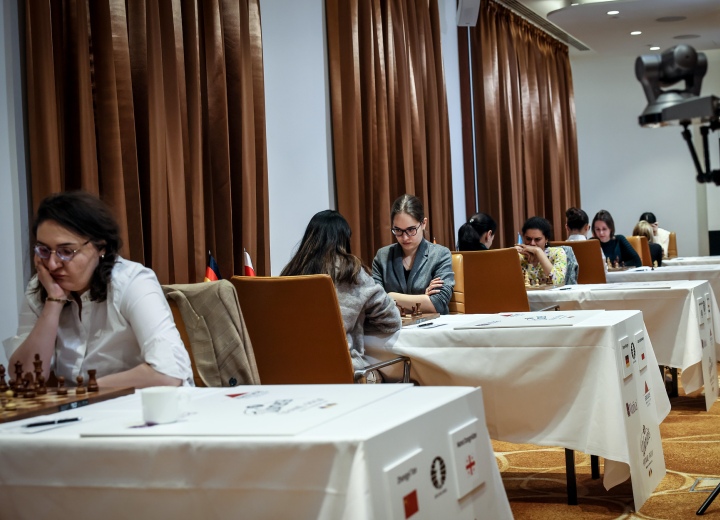
By IM Michael Rahal (Munich, Germany) Humpy Koneru, India’s number one female player, missed the opportunity of a lifetime this afternoon in the tenth round of the Munich Women’s Grand Prix. In a must-win situation, Humpy ground down her opponent Alexandra Kosteniuk with the Black pieces in a spectacular performance, only to misplay a queen ending and allow Kosteniuk to escape by the skin of her teeth. A very close call indeed for Kosteniuk, who keeps her one-point lead going into the last round, where she will face Zhu Jiner with Black. Tie-breaks still favour Humpy, so only a draw will secure the tournament victory for Alexandra – any other result will also depend on the result of the game between Humpy and Tan Zhongyi. The ceremonial first move was performed by Lukasz Turlej, FIDE Secretary General and Munich WGP Tournament Supervisor, in the Kosteniuk-Humpy game GM Kosteniuk, Alexandra vs GM Koneru, Humpy (0.5-0.5) Undoubtedly, the game of the day. Trailing Kosteniuk by one point, Humpy decided to play for a long battle, keep some tension in the position and see if an opportunity to win came about. Most probably, Alexandra Kosteniuk would be content with a draw, keeping her one-point margin going into the last round. In an attempt to surprise her opponent and maybe take her out of her preparation, Humpy played the Open Ruy Lopez with 5…Nxe4 but chose the side-line 6…Be7 (instead of the mainline 6…b5). According to my database, Humpy had played 6…b5 at least fifteen times, but 6…Be7 definitely caught Kosteniuk off-guard. For many moves the position remained in balance: bishop pair for Humpy, better pawn structure for Kosteniuk. However, Humpy gradually increased her space advantage on the queenside and soon had Kosteniuk against the ropes. It’s hard to pinpoint a specific mistake – Humpy just outplayed her opponent. But luck was on Kosteniuk’s side this afternoon. Humpy missed a clear chance to win in a tricky queen endgame, and Kosteniuk managed to escape with a draw, keeping the lead going into the final round. “I am feeling very tired but much better than if I’d lost the game” were Kosteniuk’s feelings a few minutes after the game had finished. GM Tan, Zhongyi vs GM Dzagnidze, Nana (0-1) According to my database, Dzagnidze and Tan Zhongyi have faced each other multiple times. In a total of 24 games, the former Chinese Women’s World Champion has won nine games while the Georgian player has won seven times, with a total of eight draws. “We have played many games together; we know each other very well. I didn’t expect her opening today, so I played on the board,” said Nana Dzagnidze in the postgame interview. In this afternoon’s game, Tan Zhongyi started with the English Opening, but soon there was a transposition to the Tarrasch System in the Queen’s Gambit. Coming out of the opening, Tan Zhongyi had a slight advantage, putting pressure on her opponent’s isolated pawn. “Maybe she played too ambitiously, and I found the interesting ideas …Qb8 with the idea …Bc7-b6,” said Dzagnidze in a short post-game interview. But Dzagnidze defended well and took advantage of a small mistake in her opponent’s strategy (19.a4?) to win a pawn and force a superior endgame. With the excellent technique, she took home the full point in a very instructive opposite. “I chose the right plan to get the winning position. If the pawns would have been closer, the bishop ending might be a draw,” were Dzagnidze’s final conclusions. GM Harika, Dronavalli vs GM Muzychuk, Anna (1-0) Thirty-eight games together with twenty-five draws shows that this match-up was going to be equal. The opening was a Symmetrical English, and it quickly became clear that both players were in their preparation until move fifteen. Harika spent thirty minutes on 16.Rc1 and quickly fell into a bad position, losing a pawn. “I forgot my preparation at some point, I knew the variation, but I couldn’t recall it,” said Harika in her postgame interview. With 18…Rxb4, Muzychuk would have enjoyed a small advantage, but instead she blundered 18…e5? and Harika was back into the game, recovering the pawn with superior piece coordination. “After her blunder, I had very easy play. The bishop pair and the misplaced rook on b6 should be winning for me,” Harika explained. GM Paehtz, Elisabeth vs WGM Zhu, Jiner (0.5-0.5) Paehtz decided to mix things up this afternoon, going for the 2.c3 Alapin Variation side-line against the Sicilian. Displaying excellent opening preparation, both players blitzed out their first sixteen moves following an earlier 2021 game between Gaponenko and Berdnyk. In her preparation, Paehtz had obviously gone even further: while Zhu Jiner started to ponder her moves, she continued playing fast. “I prepared it until 20.Nb3, and then according to the super engine, the only move to keep it equal was 20…Rcd8, if I remember correctly. So, after her 20…Rfe8 I was on myself but had a nice position already,” explained Elisabeth Paehtz after the game. Her strategy worked out: under heavy pressure in the centre, Zhu Jiner decided to jettison her e5 pawn and go into an inferior ending. Zhu Jiner displayed excellent defensive technique right until the end. Even so, Paehtz missed a clear chance to win the game with 67.Rc7+! instead of 67.b7. “After four hours, it’s known that the energy level goes down. I did quite a lot of sports before the event, but apparently, it was not enough. I knew I may lose the grip at some point, and unfortunately, it happened…” Paehtz frankly recognized the importance of being on top form during these elite events. GM Abdumalik, Zhansaya vs GM Muzychuk, Mariya (1-0) Zhansaya Abdumalik and Mariya Muzychuk have played against each other many times in the past, with a more or less equal score. Facing the Sicilian for the second day in a row, Abdumalik opted for the Rossolimo Attack, transposing a few moves later to the Marozcy structure. With 13.c5, she sacrificed a pawn to damage her opponent’s pawn
2023 FIDE Constitutional Commission meeting: Report

FIDE publishes the report of 2023 FIDE Constitutional Commission meeting, which was held on 4-5 February in Belgrade, Serbia. Download Report of the meeting (PDF)
WGP Munich: Koneru or Kosteniuk – who will prevail?
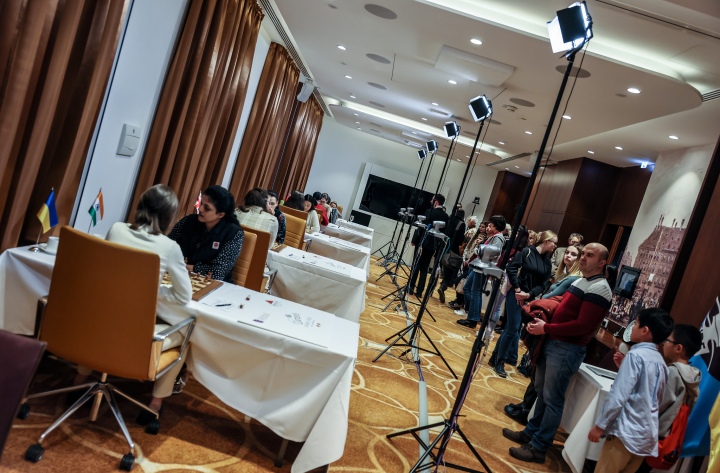
By IM Michael Rahal (Munich, Germany) The Munich Kempinski hotel witnessed this afternoon one of the most exciting rounds of the 2022-2023 Women’s Grand Prix series. The round started with the ceremonial first move, played by the German U-16 female champion, Maja Buchholz, performed in the game between Zhansaya Abdumalik and Dinara Wagner. Perhaps the presence of the German Youth team, cheering before the round, positively influenced the combative spirit of the players, or simply that they risk much more than in the open category. Either way, time trouble was epic: no fewer than four of the six games were decided around move forty. With today’s results, Kosteniuk leads the tournament with 7/9, only one point ahead of Humpy Koneru. Since they face each other tomorrow, the event is completely open. Humpy was quite pragmatic after the game – “I am taking the tournament round by round, and I am not thinking of positions. I am going to relax and start preparing for tomorrow”. GM Muzychuk, Mariya vs GM Harika, Dronavalli (0.5-0.5) A very equal match-up. My database yields a total of 36 games, with 8 wins for Muzychuk and 9 wins for Harika in previous encounters. Standing on 50%, with three rounds to go, both players were clearly interested in improving their tournament position. In classical Italian, it didn’t seem that much was happening in the opening until Muzychuk spiced things up with 24.g3. After a more or less forced sequence of exchanges, White ended up with an extra pawn, but Black’s pieces were very active, especially the rook. Both players preferred to play it safe, and a draw was agreed on move thirty-nine after a threefold repetition. GM Dzagnidze, Nana vs GM Kosteniuk, Alexandra (0.5-0.5) Trailing Kosteniuk by two points, this afternoon’s game was Dzagnidze’s last chance to make a statement for the tournament: a must-win situation. Additionally, most of their previous games ended with decisive results. The opening was a Nimzo-Indian Defence, with the so-called “hanging pawns” structure, both strategic and dynamic, ideal for both players’ styles. After a series of exchanges, the pawn structure stabilized, and the position remained equal. Going into the ending, Kosteniuk won a pawn. Maybe she could have played for a win, it’s hard to say, but taking into account the tournament situation, she decided to play it safe and agree to a draw after a three-fold move repetition. “I considered playing for a win, but in time-trouble, I couldn’t see how to improve my position and decided to agree to a draw,” commented Kosteniuk after the game. GM Abdumalik, Zhansaya vs WGM Wagner, Dinara (1-0) Facing Abdumalik’s English Attack in the Sicilian Najdorf, Wagner chose the old 6…Ng4 line, which recently fell out of fashion, substituted for the most part by 6…e5. One of the key moments of the opening was Abdumalik’s choice to play 14.Nxc6 instead of the regular 14.Nb3. Transitioning into the middlegame, the top Kazakh player made a crucial strategic decision, parting with her dark-squared bishop after 19.Bxe5: the position was very double-edged. She started transferring her pieces to the queenside in an attempt to attack Wagner’s king. Anything could have happened, but Abdumalik was on the winning side today. “I was a bit lucky because she made some mistakes in time trouble. But in general, the game was fine, we were both fighting, and I am happy that I have managed to win my first game,” a very content Zhansaya Abdumalik explained in her postgame interview. GM Muzychuk, Anna vs GM Tan, Zhongyi (0-1) According to my database, Anna Muzychuk and Tan Zhongyi have played 21 times, with a roughly equal score: 6 wins for Tan Zhongyi and 5 wins for Anna Muzychuk, with a total of 10 draws, so a close fight was expected, especially as both of them are currently standing near the middle of the standings. Muzychuk chose the sharp Keres Attack against the opponent’s Sicilian Defence, forcing her on the defensive. Things seemed to be going well when suddenly she decided to sacrifice her h4-pawn, which was certainly a double-edged decision. Muzychuk was able to open several lines to Tan Zhongyi’s king, but in exchange, the former Women’s World Champion installed a monster knight on e5, dominating the board. Muzychuk began to lose her way and soon found herself in a hopeless situation. Even though she could have decided the game earlier by tactical means, Tan Zhongyi preferred to transition into a double rook ending. “The knight on e5 was the key strategic element of the game,” explained Tan Zhongyi after the game. GM Koneru, Humpy vs GM Paehtz, Elisabeth (1-0) According to my database, Humpy has traditionally been a very tough opponent for Paehtz. They have faced each other on 13 occasions, with 9 wins for Humpy and only 3 wins for Paehtz. For today’s game, the German number one opted for the King’s Indian Defence, which quickly transposed into one of the sharpest positions of the Benoni. Paehtz blitzed out her opening moves and sacrificed a pawn for the initiative, a typical idea in these positions. Paehtz could have achieved full equality with 18…Rxb2, but instead chose 18…f5, falling quickly into a very unpleasant position. “Even though I am a pawn up, it’s quite a complicated position. It’s more to do with who is controlling the central squares,” Humpy explained to IM Michael Rahal, FIDE Press Officer for the event. “She has to try …Ng4, …Qh4, and at some moment play …Ne5 with counterplay.” WGM Zhu, Jiner vs IM Kashlinskaya, Alina (0-1) The last game to finish was the most exciting. Poland’s number one player opted for the French Defence for the second time in the event. Zhu Jiner had prepared the Advance Variation, one of the most strategic lines against the French. “I generally play the line with …Nh6, but today I went for the main line …c4 to play a long game, in which I thought I might understand some nuances better,” Kashlinskaya explained her opening choice. It’s hard to say
Robert Katende: Have a heart that loves people no matter who they are

SOM Chess Academy is not your standard chess school. Its founder, Robert Katende, managed to bring chess into the lives of the children of Uganda’s slums. Starting with a single chessboard and a desire to help, he managed to uplift the lives of thousands of disadvantaged children. Katende is probably best known for being the man who taught Phiona Mutesi, Uganda’s Women Candidate Master, whose story was turned into a Disney movie, “The Queen of Katwe”, released in 2016. Erick Takawira, Councillor of the FIDE Social Commission, interviewed Robert Katende to learn more about bringing chess to slums and using it to impact people’s lives for the better. – Robert, where did your journey start? What inspired you? There must be something which kicked in you to say, I want to do this kind of work. – The most intriguing factor is that I just wanted to figure out how I could contribute to the well-being of the children who were struggling in the slum life, having lived it myself. I was asking myself how it could be a solution for some of the learners who were craving and struggling to see how they could make it in life. I did not have a full idea that it would ever be as it has turned out to be anyway. – Is this where SOM comes in, or were you doing it without any organization linked to it? – I was using soccer to reach out to the children in the community through Sports Outreach but realized some of them were not interested, and the majority of the girls, soccer wasn’t their thing. My heart was like: how can I reach out to these kids? And I gave birth to the idea of chess. I knew how to play chess and had a chess set, so I decided to introduce them to the game and make it a platform where I engaged with them. – Where are you located? – We have a center where I am right now in Kampala. This is where we hold all our events, and it has been ten years since we acquired this space. We call this SOM Chess Academy Arena on Mityana Road. We are also developing another small center in Katwe where the program started from. – Who can be part of SOM? – Anyone can be part of our programs. Although our heart is reaching out to the less privileged individuals, we are open to everyone who embraces the vision. To be a member of SOM, every child is required to register and subscribe by paying Ugx 10,000 (about $3) a year. It gives access to the teaching program, the feeding program, Vocational skills study and education support opportunities. – What are the lessons you could say you have learnt in this journey? – When I started bringing chess into the less privileged communities, especially when we came to Katwe, people did not understand what chess was all about. It was very challenging allowing children to be part of it as most thought it was gambling. Space was a challenge, so we initially had to conduct the program from a former dumping site. The children themselves wouldn’t embrace it, but some would hang around because of the feeding program. Taking kids to a tournament positively struck people’s minds that it was bigger than they first thought. – What challenges could you say you are facing? Where do you look for hope? – The biggest challenge right now is funding because the needs are many to realize and sustain our vision. It is really encompassing in terms of financial and human resources. We look forward to partners willing to work with us. We are now facing a challenge, especially after COVID, because most of our partners fell off after that. – Do you have any strategic partnerships? Are there any organizations supporting the work you do? – We don’t have many organizations that have partnerships with us; most of them are more like one-time grant people. Sports Outreach is our key supporter and doubles as our mother organization, then the Robert Katende Initiative. The rest are one-time supporters such as Go Campaign, Issroff Foundation, Rosie J Coe foundation, Bilu Uganda, World Vision, SBC, FIDE and UCF. Then we have single families and individuals, the Robert Katende Initiative, registered in the USA, which was founded in 2017 with the sole purpose of supporting the two learners, Benjamin Mukumbya and Phiona Mutesi, that had gotten into the US Colleges on a tuition scholarship. We need funding and thus call for partners to invest in this vision so that we can sustain what we are doing and also be able to scale the impact in other communities across Africa. – Are there any other projects you have undertaken to educate the children and make their lives better? – Chess is more of a teaching tool we use to identify the potential of the learners. We guide and direct them to their destiny. We have an education support program where over a span of 19 years, we have close to 40 graduates who have gotten through SOM programs. We have engineers, doctors, accountants etc. We have vocational skills and computer training programs. The Centre has a computer lab, and we plan to start coding in 2024. – What would you say is the social impact of chess? – Chess bridges the social gap created economically and levels the ground. It brings people from all spheres of life on the board to reason together and interact. Chess bridges the two ends together so that irrespective of gender, age, economic status, or educational background, people get a platform to engage and learn from each other. – What is your hope for SOM? What do the programs need to grow? – Our theme is to restore hope and transform lives. We need to have connectivity and good networking with supporters, that connectedness is going to break the vicious cycle
Jorge Vega Fernandez (1935-2023)
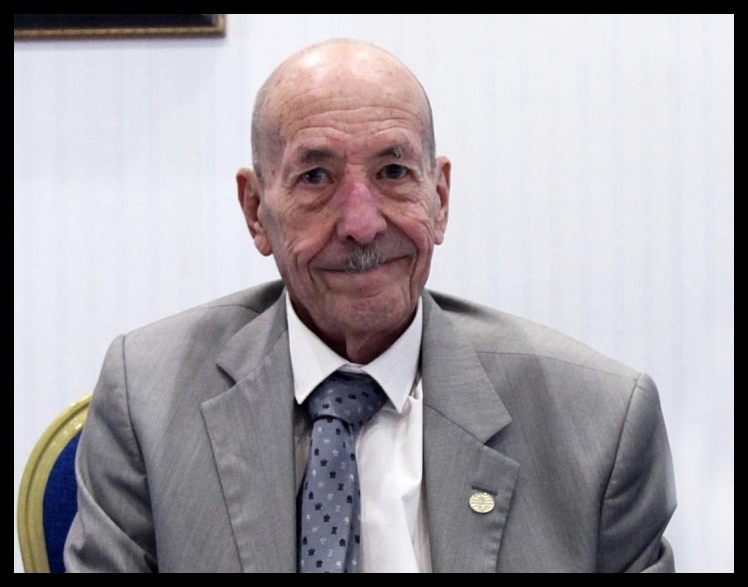
FIDE is deeply saddened to hear of the passing of Jorge Vega Fernandez. Honorary Member of FIDE, he was a key figure for chess in Americas, being the President of Confederation of Chess for Americas (CCA) for nearly 20 years. Jorge Vega was born in Cuba in 1935 and lived a long and eventful life. He took part in the Cuban Revolution, which overthrew the Baptista regime in 1959. Legendary Che Guevara ordered him to carry a pocket chess set so that they could play chess between battles with government troops. The hero of Cuban revolution was the best man at Jorge’s wedding. Jorge Vega was a Cuban delegate since 1977, Zonal President since 1974, Central committee member since 1974 and FIDE Bureau member since 1979. Because of his international links through chess, he was imprisoned by the Cuban authorities and spent a long time in solitary confinement. After strong diplomatic pressure from the Canadian Government organized by John Prentice, Jorge was released and allowed to leave Cuba. He then moved to Mexico. In 2002, he was elected President of Confederacion de Adjedres para America (CCA) and held this position for the next 20 years. He unified what had been a very divided body until then, and it became a very influential part of the FIDE family. His friends in chess will never forget him and cherish plenty of sweet moments. Nigel Freeman, President of the Bermuda Chess Federation and former FIDE Executive Director and FIDE Treasurer, shared one of them. When Jorge was 80, he had a medical checkup, and the doctors asked him how he managed to have the constitution of someone more than 20 years younger, and he replied: “I drink a lot, I smoke a lot and never eat green vegetables.” FIDE extends its sincere condolences to Jorge Vega Fernandez family, friends, and loved ones. Photo: Anastasia Karlovich