

WGP Munich: Kosteniuk extends her lead
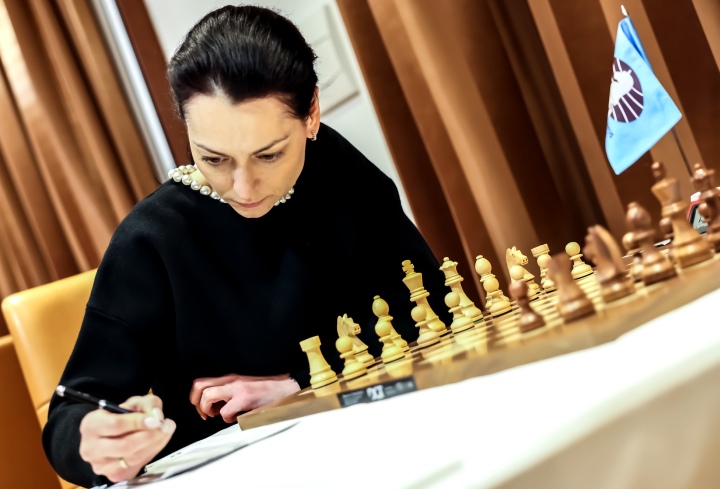
By IM Michael Rahal (Munich, Germany) Alexandra Kosteniuk increased her lead this afternoon in the Munich leg of the 2023 Women’s Grand Prix after a fine performance against Anna Muzychuk. With 6.5/8, and with only three games to go, she is the clear favourite to take home the trophy. “My husband – GM Pavel Tregubov – will be happy today. When I came back to the room in the last four games, he was always asking whether I had some pills to calm down his nerves!” were Kosteniuk’s first words in her post-game interview. With her impressive win today, Humpy Koneru secures second place and, with three rounds to go, seems like the only player with a chance to catch Kosteniuk. However, Humpy keeps an open mind: “I have had a lot of disappointing games like yesterday against Zhu Jiner when I missed a completely winning position. I don’t want to think much about the standings and just focus on the game.” Moritz Opfergeld, CEO of the Munich Residential Group, made the ceremonial first move for Alina Kashlinskaya in her game against Koneru Humpy today. However, Alina replaced his chosen 1.d4 with 1.e4! GM Harika, Dronavalli vs GM Abdumalik, Zhansaya (0.5-0.5) The first game to finish this afternoon ended in an excellent result for Zhansaya Abdumalik. After a shaky start, the top Kazakhstan female player is slowly but surely getting back into the event, and today she drew effortlessly with Black against Harika. In the solid Vienna variation of the Queen’s Gambit Declined, they repeated the first fifteen moves of a well-known 2011 game between Levon Aronian and Vishy Anand, in which White sacrifices a pawn for the initiative. Aronian won that game, but instead of playing for the attack, Harika preferred to get the pawn back and transition to a totally equal ending. A draw was agreed upon just after they reached move thirty. GM Tan, Zhongyi vs GM Muzychuk, Mariya (0.5-0.5) For this game, the former Women’s World Champion prepared an interesting pawn sacrifice in the English Opening. In exchange she got a bishop pair and certain initiative on the c-file. Displaying excellent positional touch, Muzychuk decided to return the pawn and exchange the rest of the pieces, agreeing to a draw on the move thirty-three. IM Kashlinskaya, Alina vs GM Koneru, Humpy (0-1) A very solid game. Already in the opening, Kashlinskaya went for piece trades, and soon the queens were also off the board. It’s hard to say if the previous score between the two (4 wins and 1 draw for Humpy) influenced Kashlinskaya’s decision to play it safe. Soon only one bishop a piece was left on the board, with Humpy pressing for the win thanks to a very slightly favourable pawn structure. Kashlinskaya defended very well until time trouble: fate struck on move thirty-six. It’s impossible to confirm that Kashlinskaya would have drawn for sure with a move such as 36. Kd2 but 36.h4, allowing the Black king to penetrate via the d4 square, is a clear blunder that left her with no chance at all to save the game. “The endgame is very comfortable for me: it’s White that has to defend. Of course, h4 is a blunder; probably she should have tried to block with her king on d1 and c2,” was Humpy’s analysis in her post-game interview. WGM Wagner, Dinara vs WGM Zhu, Jiner (0-1) Playing with White in the Nimzo-Indian main line Wagner obtained the bishop pair, but Zhu Jiner’s pieces remained very active. The position remained equal until move twenty-three when Wagner unexpectedly blundered with 23.Qc2? allowing a very nice tactical shot. Zhu Jiner isn’t one to miss such an opportunity, and after a few-minute-thought sacrificed her knight with 23…Rxd1 24.Rxd1 Nxf3! winning material. After a forced line that both players calculated correctly, an opposite-coloured bishop ending was reached. According to the engine analysis, Wagner had serious drawing chances but only by capturing the pawn on h5 on move thirty-five. Instead, low on time, she went for the a7-pawn, only to realise that her bishop would be trapped. Zhu Jiner didn’t give her another chance and wrapped up the game with great technique. GM Paehtz, Elisabeth vs GM Dzagnidze, Nana (1-0) According to my database, Paehtz and Dzagnidze have played together on 40 occasions, with the Georgian GM outscoring her opponent by 17 wins to 8 with 15 draws. In today’s game, Paehtz went all-out for the win with a very aggressive approach against Dzagnidze’s Sicilian Najdorf. The key moment of the game was move twenty-three. Dzagnidze initiated a sequence of captures with 23…Rxc3, followed by a positional queen sacrifice. With fifteen moves to go and less than ten minutes each on the clock, it was hard to understand even from the outside if Paehtz’s queen was stronger than Dzagnidze’s combined rook plus knight plus an extra pawn. Dzagnidze’s 32…Nh7 was the decisive mistake, allowing Paehtz to win more material and dominate her opponent in a queen plus pawns vs rook plus pawns endgame. GM Kosteniuk, Alexandra vs GM Muzychuk, Anna (1-0) Spending more than an hour of thinking time on your first ten moves at this level is generally a mistake. Even though Muzychuk managed to equalise going out of the opening, she sacrificed a pawn to exchange queens to fight for a draw in a slightly worse ending. Several grandmasters have been able to hold the position to a draw, but it’s not an easy task. Muzychuk defended with great precision for many moves, but approaching time trouble, Kosteniuk picked up the pace with the idea 38.g5 – 39.g6 and especially 20.a5! which could prove useful in some king endings. It’s hard to pinpoint the final blunder – possibly the plan initiated with 46…Rh8 – but in any case, Kosteniuk demonstrated excellent endgame technique to bring home the point. “Time management was a key factor in today’s game. In the first time trouble, she definitely did something wrong; she gave me chances to improve my position on the kingside,” Kosteniuk explained
WGP Munich: Dzagnidze closes the gap
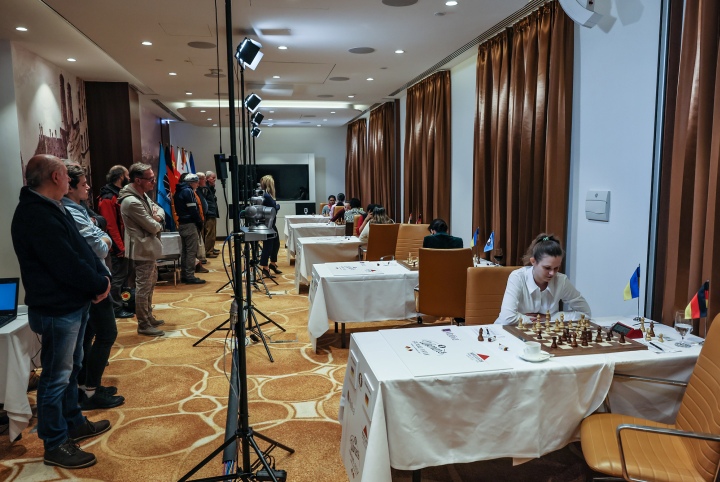
By IM Michael Rahal (Munich, Germany) After a stunning performance this afternoon against Alina Kashlinskaya, Nana Dzagnidze closed in on tournament leader Alexandra Kosteniuk, and with four rounds to go, it’s all up for grabs. The former 2017 European Women’s Champion from Georgia displayed her excellent skills handling the white side of a classical King’s Indian and, coupled with some other surprising results, made her claim for the title in Munich. After seven rounds, she scored 4.5 points. “It’s a very long tournament, and I am already quite tired, but I think that I am playing very well, and I hope that game by game, I can prove my strengths,” said Nana Dzagnidze after the game. Still in the lead with 5.5/7, Kosteniuk might have used up her seven cat lives this afternoon, saving a completely lost position against Mariya Muzychuk, while Humpy Koneru also missed a huge opportunity to move into second place in her game against Zhu Jiner. “This time, I’m just lucky to score more points than I am supposed to according to the positions I get after the openings. But these tournaments can go either way. Sometimes you play well, and you just don’t score at all,” was Alexandra Kosteniuk’s point of view. GM Muzychuk, Anna vs GM Paehtz, Elisabeth (0.5-0.5) The first game to finish was a solid affair. Although the English Attack in the Sicilian Najdorf generally suggests very double-edged positions, both players decided to play it safe. After drumming up some initiative on the queenside, in an opposite-side castling, Muzychuk decided to trade queens to prevent any tactical danger. In the final position, dare I say that Muzychuk is slightly better because of her superior minor pieces, but Paehtz tripled her thinking time on the clock. Therefore, a threefold move repetition around move thirty left both players content with the result. GM Harika, Dronavalli vs WGM Wagner, Dinara (0.5-0.5) In their first game together, Harika chose the reversed King’s Indian defence, definitely catching Wagner by surprise: she had already spent more than half of her thinking time before move ten. Going into the middlegame, the position remained balanced: Wagner’s kingside was somewhat weak, but on the flip side, her pieces were very active. “I preferred my position because I think it was easier to play, and any kind of ending would have been better for me, but she played very solid,” Harika explained to IM Michael Rahal, FIDE Press Officer in Munich. With time trouble looming for both opponents, things got chaotic – it was hard to say which of the two kings was under the heaviest attack. “I think I made a mistake on my fortieth move in time trouble. After that, I am worse, but it is very complicated to understand, and with one small error, the position can equalize very easily, which is what happened.” GM Abdumalik, Zhansaya vs GM Tan, Zhongyi (0.5-0.5) The games between two of the best Asian players have always been quite exciting. In 15 games, only six draws and nine decisive results were registered. Possibly inspired by her opponent’s choice yesterday, Tan Zhongyi tried out the Caro-Kan defence – she always plays Sicilian and Pirc. Zhansaya Abdumalik repeated the Fantasy variation 3.f3 that she used successfully in the recent World Blitz and Rapid event in her hometown Almaty. However, something went wrong in the opening. After 14…c5! White was already on the defensive. Abdumalik decided to sacrifice a pawn to avoid greater problems later, but the compensation just didn’t seem to be there. However, this time luck was on her side. “I should have played 20…Re7 instead of 20…Re8, and then I totally missed her sacrifice with 25…Bh6. After that, I think it’s just a draw,” Tan Zhongyi explained to us after the game. GM Muzychuk, Mariya vs GM Kosteniuk, Alexandra (0.5-0.5) A duel between former World Champions. Mariya Muzychuk (Women’s World Champion in 2015-2016) has always been a tough opponent for Alexandra Kosteniuk (Women’s World Champion in 2008-2010). According to my database, in 35 games Muzychuk has won 15, lost 6 and tied 14. Being two points behind on the scoreboard, Muzychukonly needed a victory to retain any chance to win the event. In a well-known theoretical position of the Italian Opening, and after more than 13 minutes of thought, Kosteniuk played the novelty 9…a5. Muzychuk took the same amount of time to reply with 10.Bb5, and a complicated battle began. Muzychuk missed a clear win on move 21. Although her choice 21.Nc4 is actually quite good, the alternative 21.b4! wins on the spot as the threat Rxe6 followed by Bb3 is decisive. “I felt that the position was very shaky, and it seems that I was losing in one move,” Kosteniuk explained in her post-game interview. “I thought that after 20…f5 I would be OK, but apparently I am not, there are a lot of pieces hanging”. A few moves later, Muzychuk could have sealed the deal with 24.Rad1! but her choice 24.Bg5? proved to be a clear blunder, allowing 24…f4! with the threat 25…Qxh3 winning. Back in the game, Kosteniuk forced a draw by perpetual check in a bishop + knight vs rook + two pawns ending. GM Dzagnidze, Nana vs IM Kashlinskaya, Alina (1-0) In 46 previous games, Dzagnidze built up a massive 33-13 advantage against Kashlinskaya. Playing with White, it would be fair to say that she was a favourite in today’s encounter. Poland’s number one female player went for the King’s Indian Defence, her main choice against 1.d4, although in their most recent game played at the Chennai Women’s Olympiad, her choice had been the Ragozin variation in the Queen’s Gambit. “I don’t usually play this variation, I generally go for g3-setups but I had prepared this line, and it’s not easy to play for Black,” Dzagnidze explained in her post-game interview. When transitioning into the middlegame, the play became very sharp. In an opposite-side castling position, Kashlinskaya forced trading of queen’s, reducing her opponent’s attacking potential, in exchange for transitioning into a worse endgame,
FIDE – ISF World School Teams Chess Cup 2023 announced
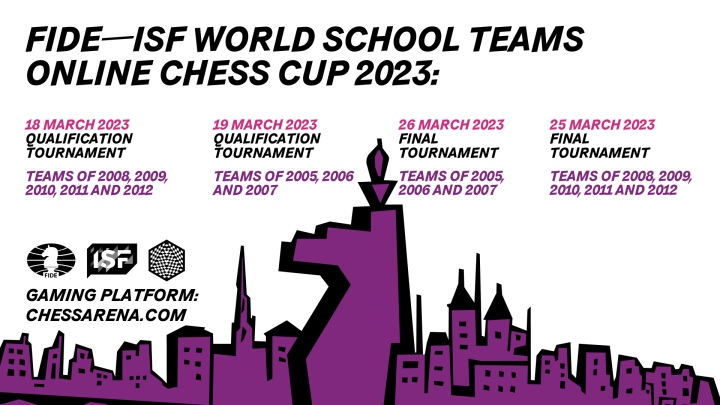
FIDE, ISF (the International School Sport Federation) and World Chess are proud to announce the FIDE – ISF World School Teams Online Chess Cup 2023, taking place in March 2023. This exciting event provides a platform for schools from FIDE and ISF member countries, as well as students from around the world*, to connect with chess enthusiasts from across the globe and showcase their skills in an official international chess tournament. With chess in schools becoming increasingly important, organizers of the FIDE – ISF World School Teams Online Chess Cup 2023 are eager to support this initiative to integrate chess into the school educational system. “Chess is a unique game – both extremely sportive and educational. We are excited to organize the Online Schools Chess Championship together with ISF. It is a great event that we hope will create a competitive mood but also motivate the school leaders to engage their students in further training and learning,” says FIDE President Arkady Dvorkovich. The tournament will feature two age categories, U15 and U18, with an expected 200 teams from around the world participating. Each school team must consist of 4 to 7 full-time students from the same school. The winners and medalists will be rewarded with exclusive team training sessions with world-famous grandmasters, chessboards signed by the GMs, subscriptions for the World Chess Masterclasses program, and FIDE Online Arena premium membership packages. The tournament will be held online on the FIDE Online Arena, with the final stage broadcast live on World Chess and FIDE’s YouTube channels. The program of the FIDE – ISF World School Championship Online Chess Cup 2023: March 18 2023: Qualification tournament 2008, 2009, 2010, 2011 and 2012 – Teams March 19 2023: Qualification tournament 2005, 2006 and 2007 – Teams March 25 2023: Final tournament 2008, 2009, 2010, 2011 and 2012 – Teams March 26 2023: Final tournament 2005, 2006 and 2007 – Teams The tournament registration will begin on February 06 and be open until March 11, 2023, at isf.fide.com The Bulletin for the FIDE – ISF World School Teams Online Chess Cup 2023 can be found here:wctour-images.worldchess.com/files/Bulletin_v2.pdf?_ga=2.36026080.1730883558.1675861644-801562242.1640172432 * Except for schools from Russia and Belarus. About International School Sport Federation (ISF) Founded in 1972, the International School Sport Federation (ISF) is an international non-profit sport organization, acting as the umbrella organization and governing body for national school sport organizations around the world, organizing sport, and educational events for youth from 6 to 18 years old. Recognized by the International Olympic Committee (IOC) since 1995, the ISF currently consists of 132 members all over the five continents organizing over ten events per year and has more than 30 different sports included in its competition, key vision of ISF , A world where sport and education provide opportunities for all students to empower themselves and to become active citizens and to foster healthier communities. For more information visit ISF website: https://www.isfsports.org In September 2021, FIDE and ISF signed a memorandum of understanding to ensure the development and promotion of chess through school sport. The document signed within the framework of the School Sport Forum held in Serbia encourages and supports the education of youth through chess sport and culture, contributes to the social and intellectual development of youngsters, and promotes chess sport and chess in education on a local and international level. About FIDE The International Chess Federation (FIDE) is the governing body of the sport of chess, and it regulates all international chess competitions. Constituted as a non-governmental institution, it was recognized by the International Olympic Committee as a Global Sporting Organization in 1999. FIDE currently has its headquarters in Lausanne, but it was initially founded in 1924 in Paris under the motto “Gens una Sumus” (Latin for “We are one Family”). It was one of the very first International Sports Federations, alongside the governing bodies of the sports of Football, Cricket, Swimming, and Auto Racing. It is now one of the largest, encompassing 199 countries as affiliate members in the form of National Chess Federations. Chess is nowadays a truly global sport, with dozens of millions of players on all the continents and more than 60 million games on average played every day. About World Chess World Chess is a London-based chess gaming and entertainment company and FIDE’s official commercial partner. World Chess organized the FIDE Championship Matches in the USA and the UK, and revolutionized the sport by signing the biggest media partnerships in history. World Chess develops Armageddon, the chess league for prime-time television. World Chess also runs FIDE Online Arena, the exclusive official chess gaming platform. More at worldchess.com.
FIDE distributes €30,000 among chess veterans

After carefully considering the numerous applications received, the special panel appointed by the FIDE Council decided that these will be the twelve chess players, coaches, and promoters to benefit from the first instalment of FIDE’s support to chess veterans in 2023: Yochanan Afek (Israel)Igor Yarmonov (Ukraine)Jesús Nogueiras (Cuba)Valeri Beim (Austria)Elmira Aliyeva (Azerbaijan)Irina Chelushkina (Serbia)Nukhim Rashkovsky (Russia)Luben Spasov (Bulgaria)Vladimir Egin (Uzbekistan)Tamara Vilerte (Latvia)Carlos Magno Camaton Borbor (Ecuador)Giorgi Menabde (Georgia) A total of €30,000 will be distributed among them, each receiving €2,500. As we did on previous occasions, we would pay tribute to these illustrious veterans with a few words about each one of them, summarizing their careers and achievements. Yochanan Afek (Israel) Born (in 1952) and raised in Tel Aviv, Israel, IM Yochanan Afek has had a long and versatile chess career. As a player, he took part in countless open tournaments in Israel and all over Europe and played for teams in six countries. He achieved his best result in Paris in 2002, showing a performance of 2680. Photo: Frans Peeters As a trainer, he has worked with individuals and teams at various levels and age groups for over fifty years. From 1987-1997 he served as the trainer of the Israeli national junior team, accompanying Israeli youth players to the World and European championships. A talented organizer, he was a full-time director of the Tel-Aviv municipal chess club from 1984-1990. Back in 1987, Yochanan founded the Tel-Aviv International festival and ran ten of its most successful editions as well as many other chess events also on behalf of the Israel Chess Federation. He has been an International Arbiter since 1988. For many years Yochanan Afek was the editor of the weekly chess column in two Israeli daily newspapers, “Maariv” and “Äl Hamishmar”. As a journalist, he has covered national and International major chess events for several European magazines and written hundreds of articles on various chess topics in the English monthly CHESS, the German Schach, the endgame quarterly EG, Chess Informant and others. Yochanan authored and co-authored 12 books, including “Invisible Chess Moves” (New in Chess Book of the year 2011), “Extreme Chess Tactics” (Gambit 2017), “Practical Chess Beauty” (Quality Chess 2018 short list of book of the year), “Anthology of Miniature Endgame Studies” (Chess Informant 2022). As a problemist, he has composed hundreds of chess problems in various genres, notably endgame studies and won more than 100 prizes. As a member of the Israeli solving team, he won silver and bronze in 1977 and 1978. In 2015, he was awarded the title of Grandmaster of Chess Compositions. I am also International Judge for endgame studies. Since 2003 Afek has been serving as the editor of the Studies section in the leading British magazine “The Problemist”. Igor Yarmonov (Ukraine) IM and FIDE Master in chess composition Igor Yarmonov was born in 1967. A lifelong disabled person, Igor won five World Championships for people with disabilities. Yarmonov is also a well-known chess problemist. His first chess problem was published in 1982. Since then, he has been among the prize winners of the Ukraine Championships in composition. In total, about 250 compositions authored by Yarmonov with different genres are published. Photo: Inna Lazareva/Times of Israel In late 2022 Yarmonov and his wife fled from besieged Mariupol and sought refuge in Israel where he currently resides. Valeri Beim (Austria) Valeri Bein was born in Odessa, a city known for its rich chess tradition. Under the guidance of well-known specialist Samul Kotlernman, he quickly progressed and became a master after tying for second place in the Ukrainian championship (1972). Beim relatively early switched to coaching in his native city and started working with young people. Beim’s chess career got a real boost after he immigrated to Israel. He quickly completed the necessary IM norm and then booked his place in the Israeli team at Chess Olympiad in Novi-Sad (1990). In the early 1990s, Valeri stringed together several good results in international competitions and became a grandmaster. In 1994 he won a tournament in Budapest (1994) and tied for first place with Zoltan Almasш in Linz three years later. Photo: Winfried Wadsack After moving to Austria, he returned to coaching and worked with many young local players. A prolific author, he penned several popular books, including How to Play Dynamic Chess, How to Calculate Chess Tactics, Chess Recipes from the Grandmaster’s Kitchen, Understanding the Leningrad Dutch, and many others. Carlos Magno Camaton Borbor (Ecuador) Born in 1953, FM Carlos Camaton has had a long career as a chess player, coach and organizer. A many-time champion of his native province Guayas (the largest in Eсuador), Carlos played for his country at the XXI Chess Olympiad in Nice (1974) and the World Student Team Championships in 1974 and 1977. For over fifty years, Carlos has been relentlessly teaching and popularizing chess in Ecuador, training junior chess teams and organizing various events, including the massive Malecón 2000 Guayaquil – Ecuador (1250 boards) and the First Chess Festival. Jesús Nogueiras (Cuba) Born in 1959 in Santa Clara, Cuba, Jesús Nogueiras made a name for himself at the World Student Championship (1977), where he helped his national team to win bronze. Two years later, he became GM following his strong showing in Kecskemet (1979). In 1985 Jesus Nogueiras became the first Cuban participant of the Candidates after finishing second at the Interzonal in Taxco, ahead of Tal, Romanisin, Balashov, Brown and Speelman. Five-time Cuban champion Jesus participated in 14 Chess Olympiads (1980—2008) as a national team member, playing on the first board seven times. Photo: https://ajedreznoticias.com/ His major tournament victories include the Capablanca Memorial in 1984 and the Torre Memorial in 1997. Currently, FIDE Senior Trainer Jesus Nogueiras work with young Cuban players. Elmira Aliyeva (Azerbaijan) Born in 1954, Elmira Aliyeva became the first-ever Azerbaijani woman to earn the Master title. The 13-time national champion, she played for the Azerbaijani team in numerous Chess Olympiads and European Championships. Her prolific playing and coaching career has stretched over fifty years.
WGP Munich: Six draws in Round 6
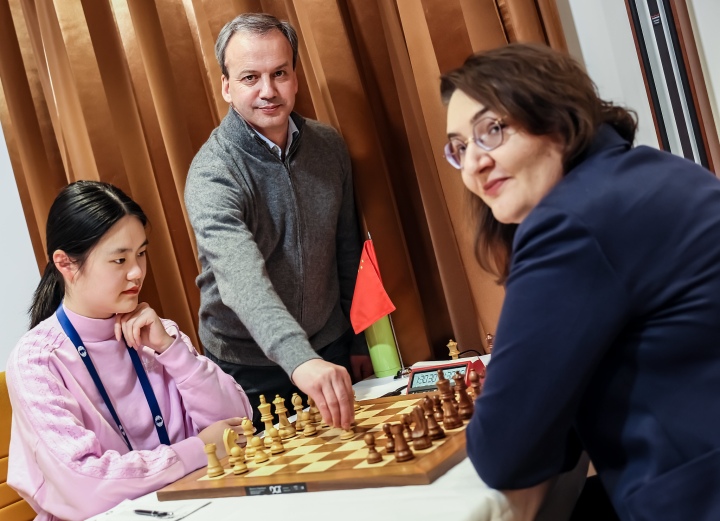
By IM Michael Rahal (Munich, Germany) The president of the International Chess Federation, Arkady Dvorkovich, visited the women’s Gran Prix this afternoon and performed the ceremonial first move on the Zhu Jiner-Nana Dzagnidze board. Interviewed before the round by FIDE Press Officer for the event, IM Michael Rahal, Dvorkovich said he was very happy to be back in Munich for such an exciting tournament. “Compared to the Open section, there are not so many tournaments for women. That’s why we decided to keep the Grand Prix series, to provide more opportunities for ladies to compete directly and have a chance to qualify for the Candidates Tournament. In a short interview, Dvorkovich also answered questions about the tragic situation in Turkey, gave his opinion on the latest debate regarding the decline of classical chess, and explained the reason why he couldn’t play tournament chess. Enjoy the full interview here. GM Paehtz, Elisabeth vs GM Muzychuk, Mariya (0.5—0.5) According to my database, Paehtz and Mariya Muzychuk had faced each other twenty-one times with a perfect 7-7-7 record – seven wins a piece and seven draws, a very even-matched pairing. It was no surprise, therefore, that this was the first game to finish in a draw after just under one and a half hours of playing time. In a Four-Knights opening, Muzychuk went for a theoretical pawn grab in the opening, which the engine (and several top-level games) suggest is completely equal due to active compensation. After further simplifications, a draw was agreed on move 30 after a threefold repetition. Both players had a lot of time still on their clocks, pinpointing that they had prepared the opening very well. IM Kashlinskaya, Alina vs GM Muzychuk, Anna (0.5-0.5) In previous encounters, Anna Muzychuk had outscored Alina Kashlinskaya by a tiny margin: four wins against two with a few draws. In fact, their most recent game, in the 2022 Women’s European Team Championship, also ended in a draw. For today’s game, Muzychuk chose a symmetrical variation of the Queen’s Gambit Accepted. Going into the middlegame, she achieved a very pleasant position in which her pair of strong centre knights outweighed the potential strength of Kashlinskaya’s pair of bishops. With not much to play for, a draw was agreed on move thirty-one. GM Kosteniuk, Alexandra vs GM Abdumalik, Zhansaya (0.5-0.5) To date, Kosteniuk had a hugely favourable score against Abdumalik, a ten-three result with only one draw. It is a surprising statistic that only shows the fighting spirit these two players bring to the board. Against Abdumalik’s Caro-Kan, Kosteniuk went for the dangerous 4.g4 Bayonet Attack, followed by the interesting 7.e6 pawn sacrifice, which, from the outside, seemed to catch her opponent by surprise. “I decided to play the Caro-Kan today, for the second or third time in classical chess, and she surprised me with the g4 move, as she usually plays other lines,” explained Zhansaya Abdumalik, who was kind enough to pop into the press centre for a quick chat. Kosteniuk might have blundered on move nine – the engine suggests 9…Qg3+ to be good for Black – but in any case, the position remained very complex, with both kings under severe attacks. Understanding the dangerous nature of the position, Kosteniuk opted to exchange queens and transition into an approximately equal endgame. “For me, it’s nice to play new openings, interesting positions. I’m not playing too well in this tournament, so I have nothing to lose,” were Abdumalik’s final words. GM Tan, Zhongyi vs GM Harika, Dronavalli (0.5-0.5) Having played 38 games to date, with a score of 13 wins for Tan Zhongyi and 11 for Harika with 14 draws, this match-up proved to be equal. Harika went for the Tarrasch Defence in the Queen’s Gambit Declined, an interesting option against the solid Chinese representative. The former Women’s World Champion decided to spice things up following a recent 2022 game between Aronian and Carlsen. However, very well-prepared, Harika simplified into an ending in which she had a slight edge due to a slightly better pawn structure, but apparently not enough to win. After the game, Harika came to the press centre to check for improvements with the journalists there, but no obvious way to secure an advantage was found. WGM Wagner, Dinara vs GM Koneru, Humpy (0.5-0.5) Contrary to most of her games in the first half of the tournament, Wagner’s opening preparation for today’s game was top-notch. Not only did she obtain a very nice opening advantage with the novelty 12.g4, but she was also significantly ahead of her opponent on the clock. Although Humpy Koneru did spend a lot of time figuring out the best equalising sequence, she proved successful in the endeavour in her first-ever game against Wagner. After twenty moves, the engine was already suggesting full equality for Black, and the amount of time left over on the clock was similar. However, in an attempt to exchange queens, Humpy damaged her pawn structure. Even so, the limited amount of material suggested that a draw was the most likely outcome. WGM Zhu, Jiner vs GM Dzagnidze, Nana (0.5-0.5) Zhu Jiner went for the popular Advance Variation against the Caro-Kan, but Dzagnidze immediately returned the surprise by playing the trending 3…c5 thrust. A few moves later, the former World U14 Girls Champion sacrificed a pawn for the initiative. Dzagnidze defended with great precision, and around move twenty, there didn’t seem to be much compensation for the pawn: in fact, after subsequent exchanges, it became clear that only Black had realistic chances of winning. In addition, Zhu Jiner only had about three minutes left with more than fifteen moves to go. However, although Dzagnidze was pressing, Zhu Jiner defended accurately and took home the half-point. In her post-game interview, Zhu Jiner said, “I analysed this pawn sacrifice some time ago, but I forgot some of the details”. The seventh round will be played on Thursday, February 9th, at 3 PM at the Kempinski Hotel venue. The games can be followed live with commentary
Tolerance Games, Asian Chess Women’s Contest, run big in Abu-Dhabi
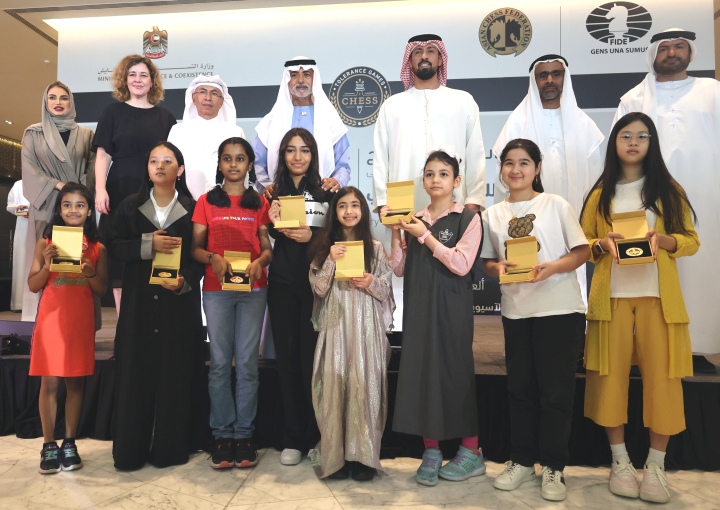
UAE Ministry of Tolerance and Coexistence, the International Chess Federation, and the Asian Chess Federation jointly held the Tolerance Games – Asian Chess Women’s Contest that took place from February 06-07, 2023, in Abu-Dhabi, UAE. The event was a part of the Global Tolerance and Human Fraternity Summit in Etihad Towers. Girls and ladies from Asia and all around the world participated in various activities, from playing chess to learning about the empowerment chess gives to women and society. The event started with the “Little Chess Star” Chess Tournament. Eight invited girls played in two qualification tournaments, followed by the final match for the title. Eisa Bashkardi Ahoud from the UAE and Zakiyabonu Muminova from Tajikistan qualified for the final from their groups. Eisa Bashkardi Ahoud bested her opponent in both games and won the tournament. https://chess-results.com/tnr726731.aspx?lan=1&art=4 https://chess-results.com/tnr726615.aspx?lan=1 https://chess-results.com/tnr726637.aspx?lan=1&turdet=YES A “Learn to play in one hour” session with a coach started right after the event. WGM and five-time Armenian Champion Mariya Gevorgyan showed many interesting problems and studies and taught girls how to play some basic and more complex rook endings. Leadership workshop “Women and Chess – Promoting Tolerance & Women Empowerment” featured Anastasia Sorokina, Chair of FIDE Commission for Women in Chess; Dana Reizniece-Ozola, Women chess grandmaster, politician, FIDE Deputy Chair of Management Board; Anastasia Karlovich, WIM, Ukrainian chess journalist and photographer; Irene Kharisma Sukandar, WGM and two-time Asian Women’s Champion; David Smerdon, GM, PhD in Economics, member of FIDE WOM Commission and Tshepiso Lopang, IA and the President of African Chess Confederation. “Chess can be used as an excellent tool for promoting tolerance and coexistence, connecting us in common humanity,” said Dana Reizniece-Ozola. “Considering chess sport as a powerful means to consolidate society, establish an atmosphere of love and tolerance and create friendships between youth without social discrimination, leading numerous social projects for many years already, as a woman, as a person with a vast experience, I want more and more girls to play chess,” stressed Anastasia Sorokina. A simul by Dana Reizniece-Ozola followed the workshop. Dana won all the games, although some players had good chances of reaching a draw. As many as 89 players participated in the Open Asian Women Blitz Chess Tournament, the 7-round Swiss event with the time control of 3min +2 sec. WGM Geldiyeva from Mahri (Turkmenistan) finished with a perfect score and emerged as the winner. Shakhnoza Sabirova, from Uzbekistan and Ahlam Rashed, from the UAE, tied for second place, netting 6 out of 7 points. Final standings: https://chess-results.com/tnr726609.aspx?lan=1&art=1&rd=7&turdet=YES The closing ceremony of the “Little Chess Stars Tournament” and Open Asian Women Blitz Chess Tournament took place on the 7th of February and was attended by His Excellency Sheikh Nahyan Mabarak Al Nabyan, Minister of Tolerance and Coexistence and His Excellency Sheikh Sultan bin Khalifa Bin Shakhbout Al Nahyan, who welcomed participants and awarded the winners. Dana Reizniece-Ozola took part in the Global Tolerance and Human Fraternity Summit and was a speaker in panel number three, Peace: Promoting Principals of Nonviolence. Photo: Stev Bonhage and Anastasia Karlovich Text: Anastasia Karlovich
Chess for Freedom in Serbia: From DIY chess set to gold medals

FIDE officials met the inmates of the Penitentiary Home in Belgrade (Padinska Skela) during their visit to Serbia this week. Deputy Chair of the FIDE Management Board Dana Reizniece-Ozola and FIDE Legal Director Aleksandr Martynov played a simul against the prisoners and talked to prison administration about the positive impact of the Chess for Freedom programme on the re-socialization and behaviour of the inmates. According to the project supervisors – Vladimir Bukvic, the warden of the Penal Correctional Facility “Padinska Skela” and Sasa Popovic, head of treatment sector – the game plays a very important role in prison, teaching its players valuable life lessons, developing critical thinking and reducing violent behavior. In October 2022, at the second Intercontinental Online Chess Championship for Prisoners, Serbia was the only country that managed to get two medals in the event – winning gold in the youth tournament and silver in the women’s section. Nebojsa Baralic, Chief Advisor to the President of the Serbian Chess Federation and Director of the 2nd FIDE Intercontinental Online Chess Championship for Prisoners, told the attendees about all the activities that have been carried out since chess was introduced to Serbian prisons. The Serbian Chess Federation, together with the Administration for the Execution of Criminal Sanctions, organize chess lessons for inmates, master classes and simuls with professional players, and conducts inter-jail chess competitions. Men’s, women’s and youth teams have extended their training and practice to prepare them for the 3rd Intercontinental Online Chess Championship for Prisoners in October 2023. Currently, prison inmates are engaged in making an outdoor chess board inside the prison’s garden. The DIY chess set will be used during the tournaments inside the prison. To learn more about the implementation of the Chess for Freedom project in different countries, visit the official website of the initiative: https://chessforfreedom.fide.com/ It can also be done by attending the first in-person Chess for Freedom Conference that will take place May 17th – May 20th, 2023, in Chicago, USA. Details and registration link here: https://chessforfreedom.fide.com
WGP 2022-2023: Missed opportunities in Munich
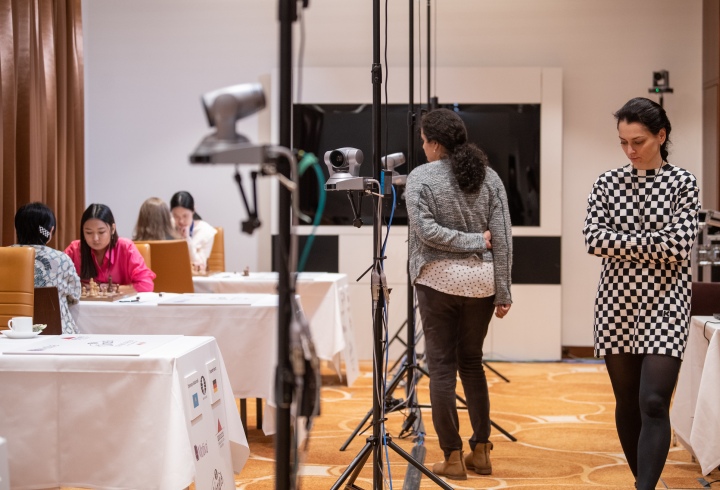
IM Michael Rahal (Munich, Germany) Time trouble is causing havoc in the Munich leg of the 2022-2023 Women’s Gran Prix, which is being disputed every afternoon in the central Kempinski hotel. Today’s fifth round saw many missed opportunities in several games: incredible turnarounds and lost positions that suddenly became won. The ceremonial first move, performed on the Harika-Kosteniuk board, was made by Daniel Stock, Head of Sports of Munich TV. A few minutes earlier, Stock interviewed top German female player Elisabeth Paehtz at the board, a rare occurrence in tournament chess but an excellent opportunity to spread the word on television. GM Abdumalik, Zhansaya vs GM Paehtz, Elisabeth (0.5-0.5) Not even an hour had gone by, and the first game had already finished. In a very theoretical Sicilian Sveshnikov variation, they went down a path that has been tread extensively in the past. More specifically, they followed a previous 2015 game between elite grandmasters Lenier Dominguez and Alexander Grischuk, which also ended in a draw by move repetition. GM Tan, Zhongyi vs WGM Wagner, Dinara (0.5-0.5) In their third game together – 2-0 for Tan Zhongyi previously – the former Chinese Women’s World Champion went for the Catalan Opening, catching Wagner by surprise. In a popular theoretical position, the German number two, five-time Russian Junior Chess Champion, spent nearly 45 minutes – practically half her total thinking time for the game – on her eighth move. Soon she fell into a difficult position, both on the board and on the clock. With less than 3 minutes on the clock – 52 minutes for her opponent – Wagner reached a critical position in the game: Tan Zhongyi sacrificed a pawn for the attack, but Wagner reacted magnificently in defence. Suddenly, she had a chance to save the game. “I have to fix my time management for the second half of the tournament,” Wagner explained to press officer IM Michael Rahal after the game. “I was trying to calculate several moves, but 45 minutes is just too much”. GM Harika, Dronavalli vs GM Kosteniuk, Alexandra (0.5-0.5) Without any doubt, Harika and Kosteniuk have one of the most extensive head-to-head records: 92 games and counting. Most of them are blitz and rapid – many of them online – and it is really close: Kosteniuk outscores Harika by 30 wins to 23 with 39 draws. In today’s encounter, Harika went for the Exchange Variation in the Slav defence, a solid line that Harika had only used a couple of times many years ago. Leaving the opening, the former World Under 20 champion from India was already leading the dance, enjoying the bishop pair and a slightly better pawn structure. Harika kept piling up the pressure with pins and threats and achieved a won position. “I was winning for sure with 46.Qe1 (instead of 46.Qc3 played in the game). It was my first idea, and I just don’t understand why I changed my mind”. Kosteniuk held on tenaciously and received her prize: a draw by move repetition. GM Muzychuk, Anna vs WGM Zhu, Jiner (0.5-0.5) After being defeated by Anna’s sister yesterday, the former World U14 Chess champion had the chance for redemption this afternoon. Playing with Black, Zhu Jiner repeated the Four Knights Sicilian variation that she used successfully against Abdumalik in the third round. Muzychuk opted for a different line involving a pawn sacrifice that wasn’t accepted, and already on move eight the position was completely new. With precise play, Zhu Jiner maintained the balance going into the middlegame: the position was equal but unbalanced, as each player had a pawn majority on one side of the board. A draw was agreed on move 38 after a threefold repetition. In her post-game interview, Anna Muzychuk was happy with the draw even though she thought she had missed some chances. GM Dzagnidze, Nana vs GM Koneru, Humpy (0.5-0.5) Another classic match-up here in Munich. According to my database, Dzagnidze and Humpy have faced each other on 57 occasions, with a very close score: 22 wins for Humpy and 18 for Dzagnidze, with 17 draws. For this game, playing with Black, Humpy chose the dangerous Kramnik-Shirov Counterattack in the English Opening. Visibly surprised, Dzagnidze went into the tank for 15 minutes and blundered twice: first with 10.d3 and on the next move with 11.bxa5 (11.b5 was necessary). Humpy quickly obtained a dangerous initiative on the queenside, and, according to the engines, surprisingly enough, Dzagnidze was already in big trouble before move fifteen. Humpy won a pawn for hardly any compensation, but her technique was off-point. With an elegant defensive exchange sacrifice, Dzagnidze managed to hold the position and force a draw. In her post-game interview, Dzagnidze explained that she was very surprised at how well Humpy had played the opening. GM Muzychuk, Mariya vs IM Kashlinskaya, Alina (0-1) In high spirits after yesterday’s round, the former Women’s World Champion opened the game with the popular Italian Opening. Kashlinskaya, Poland’s number one female player since May 2022, equalised with a timely …d5 break but soon fell into a difficult position after miscalculating the defence of her e5 pawn. A few moves later, Kashlinskaya was in dire straits: the thrust 29.g4 would have won on the spot. But winning won positions is always difficult. Approaching time trouble, Muzychuk blundered heavily, and Kashlinskaya found a nice tactic, turning the tables completely. With precise play, she liquidated into a clearly won endgame, taking home the full point and reaching 50% in the tournament. “Obviously, I am very happy with the win, although I was quite lucky today. I have a bet with my husband – elite GM Radosław Wojtaszek – that whenever I win, I have to buy dessert, so we shall have a nice dinner tonight,” a happy Kashlinskaya explained in her post-game interview. The players will enjoy a free day tomorrow and participate in the traditional Munich charity chess gala in the evening. The sixth round will be played on Wednesday, February 8th, at 3 PM at the Kempinski Hotel venue. The
Darwin Laylo wins Philippine Championship

The 2022/2023 Philippine National Chess Championship “Battle of Grandmasters” Grand Finals took place in the City of Malolos from February 1-7, 2023. The 10-player round-robin brought together three GMs, four IMs, one national master, one WGM and one WIM. Somewhat surprisingly, two out of three GMs participating found themselves at the bottom of the final standings. However, Darwin Laylo (pictured above) upheld the honour of the GM title and came out on top after scoring 6.5/9. The runner-up IM Jan Emmanuel Garcia (pictured below) finished just a half-point behind the champion. Both the winner and the runner-up completed the event unbeaten. IM Michael Concio netted 5.5 points and took bronze. WGM Janelle Mae Frayna (pictured below) and NM Mark Jay Bacojo, who tied for fifth place, turned in solid performance given their rating and picked up 32 and 49 rating points, respectively. Final standings: 1 GM Laylo, Darwin 2433 6½ 2 IM Garcia, Jan Emmanuel 2409 6 3 IM Concio, Michael 2380 5½ 4 IM Bersamina, Paulo 2427 5 5 WGM Frayna, Janelle Mae 2234 4½ 6 NM Bacojo, Mark Jay 2266 4½ 7 IM Quizon, Daniel 2397 4½ 8 GM Gomez, John Paul 2474 3½ 9 GM Antonio, Rogelio 2409 3½ 10 WIM San Diego, Marie 2157 1½ Photos: NCFP Facebook page
WGP Munich: Who dares wins
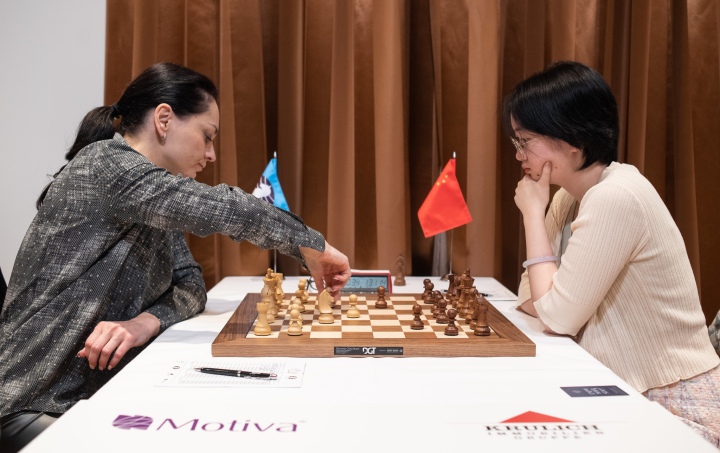
By IM Michael Rahal (Munich, Germany) “Who dares wins” is a motto made popular in the English-speaking world by the British Special Air Service, although the expression appears in a medieval Arabic book of fairy tales. Even though her opening strategy today was somewhat dubious, Alexandra Kosteniuk notched up her fourth win in a row by defeating Tan Zhongyi in a roller-coaster game with massive risks. “I’m not satisfied with my play, but of course, it’s better to have 4/4 instead of 0/4. However, I still need to improve a lot,” were Kosteniuk’s first impressions after the game. The ceremonial first move was made by Jolly Kunjappu, a performance artist and philosopher. Born in Chennai, Jolly has been living in Munich for about 50 years and is a huge chess fan. He advanced 1.c4 on the Humpy Koneru vs Anna Muzychuk board, but the pawn was immediately returned to the original square, and Humpy decided on 1.d4 for the game. The live exposure of the Munich leg of the Gran Prix is exceeding expectations. Every afternoon more than 5000 concurrent viewers are signing in on the different Twitch and YouTube channels covering the event to follow the games and grandmaster commentary. GM Paehtz, Elisabeth vs GM Harika, Dronavalli – (0,5–0,5) Harika has traditionally been a tough opponent for Paehtz: in 29 games she has emerged victorious in 9 encounters. Paehtz went for the Four Knights Opening, choosing the side-line 8.Bd2 instead of the mainstream 8.exd5 in an attempt to surprise her opponent. However, Harika came to the game well-prepared and confidently blitzed out her opening moves, equalising comfortably coming out of the opening. Although there was still a lot to play for, a draw was agreed on move 25 after a three-fold move repetition, allowing both players to keep their scores at 50%. IM Kashlinskaya, Alina vs GM Abdumalik, Zhansaya (0.5-0.5) It was a very close match-up as Kashlinskaya and Abdumalik have played 9 games with each other before, with a tiny score advantage for the Kazakhstan player. Playing the opening fast, they went for a fashionable line of the Semi-Slav defence, in which Black gets the pair of bishops in exchange for some minor pawn weaknesses. With precise defensive play, Abdumalik kept the balance in the position, and, after some simplifications, a draw was agreed on move 32. Zhansaya Abdumalik was kind enough to come to the press centre after the game to give us her impressions on the first four rounds of the tournament. WGM Zhu, Jiner vs GM Muzychuk, Mariya (0-1) In high spirits after her excellent win against Abdumalik in the previous round, Zhu Jiner opened today’s game with 1.e4. Previously, Zhu Jiner and Mariya Muzychuk had only faced each other three times with three consecutive draws. Muzychuk went for the Sicilian Defence, and soon the Marozcy structure appeared on the board, not for the first time in the tournament. Zhu Jiner enjoyed a small space advantage going into the middlegame, and when Muzychuk lashed out 22…f5, Zhu Jiner was prepared to trade off the rooks and steer into a slightly better endgame. By means of a timely pawn sacrifice, Zhu Jiner increased the pressure on the dark squares, but Mariya defended tenaciously. Unfortunately, the top Chinese female player crossed the line at some point – the plan with a5 creating a passed pawn was just too ambitious – and ultimately had to concede defeat. After the game, Mariya Muzychuk analysed her victory with commentator WIM Veronika Exler for the online audience. GM Kosteniuk, Alexandra vs GM Tan, Zhongyi (1-0) The rivalry between these two players is unparalleled. According to my database, they have disputed 26 games in classical, rapid and blitz, with a total score of 9 wins a piece and 8 draws. Playing with the White pieces and a full point ahead in the standings, Kosteniuk went for the Alapin c3 variation against Tan Zhongyi’s favourite Hyper-Accelerated Dragon defence. Muddling the waters, she tried to off-balance her opponent, straying away from theory as early as move six. However, the plan backfired. Tan Zhongyi played for the initiative, winning a pawn going into the middlegame. But she didn’t follow up correctly and Kosteniuk got back into the game. The key moment came on move 23. In a difficult position, Tan Zhongyi used up 26 of the 36 minutes left on her clock and blundered with 23…a5 allowing Kosteniuk’s attack to crash through after 24.Na3 Ka6 24.Rxb5 Rxc3 25.dxc3 Bc1 26.Rxc4 | 1-0, 34 moves GM Koneru, Humpy vs GM Muzychuk, Anna (1-0) A very equal match-up. In 38 games, they stand 8 wins for Humpy against 9 wins for Muzychuk, having tied the rest. In a side-line of the Gruenfeld Defence, Humpy bravely sacrificed a pawn on b2, which was undoubtedly part of her opening preparation for the game. “I had prepared this pawn sacrifice for the game,” Humpy explained to Press Officer IM Michael Rahal. The idea took Muzychuk totally by surprise: she used up more than half an hour to calculate the consequences of the capture. Finally, she went ahead, grabbing the pawn, only to give it back a few moves later to reduce the positional pressure. However, Humpy found an interesting tactical resource to complicate the game and, already very low on time, Muzychuk lost her way and ended up with two pieces for a rook but many pawns down. Humpy wrapped up the game with ease, scoring her first win in the event. WGM Wagner, Dinara vs GM Dzagnidze, Nana (0.5-0.5) A very interesting game, given that it is the first time they have faced each other. Wagner hasn’t started the tournament in good form, although she has had some opportunities to score in the first rounds. In an open variation of the Catalan, Wagner decided to sacrifice her d4 pawn for the initiative. It’s hard to say if it was specific opening preparation or a spur-of-the-moment decision. There was certainly enough positional compensation, but probably nothing more. From then on, it was a